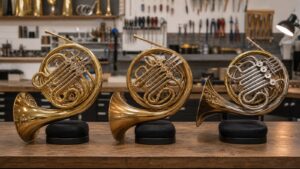
The French horn is one of music’s most captivating contradictions: elegant yet wild, refined yet heroic, capable of whispering the softest lullaby or unleashing a sonic blaze that commands an entire orchestra. Its circular shape, gleaming brass, and impossibly long coiled tubing hint at the instrument’s mysterious power, but it’s the player’s mastery of air, embouchure, and hand position that unlocks its true magic. From cinematic swells to velvety solo lines, the horn’s voice feels both ancient and futuristic, as if it carries stories from distant mountaintops and star-lit kingdoms all at once.
Step into the world of the French horn and you’ll find an instrument that rewards curiosity, courage, and precision in equal measure. Whether shaping shimmering harmonics, blending seamlessly with woodwinds and brass, or soaring above the ensemble with noble fanfares, the horn transforms every piece of music it touches. Its haunting tone has inspired composers for centuries, and its versatility continues to surprise modern musicians. Explore this fascinating instrument and discover why the French horn remains one of the most expressive and enchanting voices in the musical universe.
A: The name stuck historically, though the instrument’s major developments were German.
A: It requires precision and control, but beginners can progress steadily with guidance.
A: A horn combining F and B♭ sides, offering improved tuning and agility.
A: Through embouchure, air pressure, valve use, and hand placement in the bell.
A: The bell faces away to blend the sound and prevent overpowering the ensemble.
A: Quality models can be costly due to craftsmanship and complex engineering.
A: Classical, film music, jazz ensembles, brass quintets, and even experimental music.
A: Regular cleaning, rotor lubrication, valve string replacement, and slide greasing.
A: Typically from written F# below middle C to high C or above, depending on skill.
A: Beginners benefit from medium-depth cups with comfortable rims for control.