
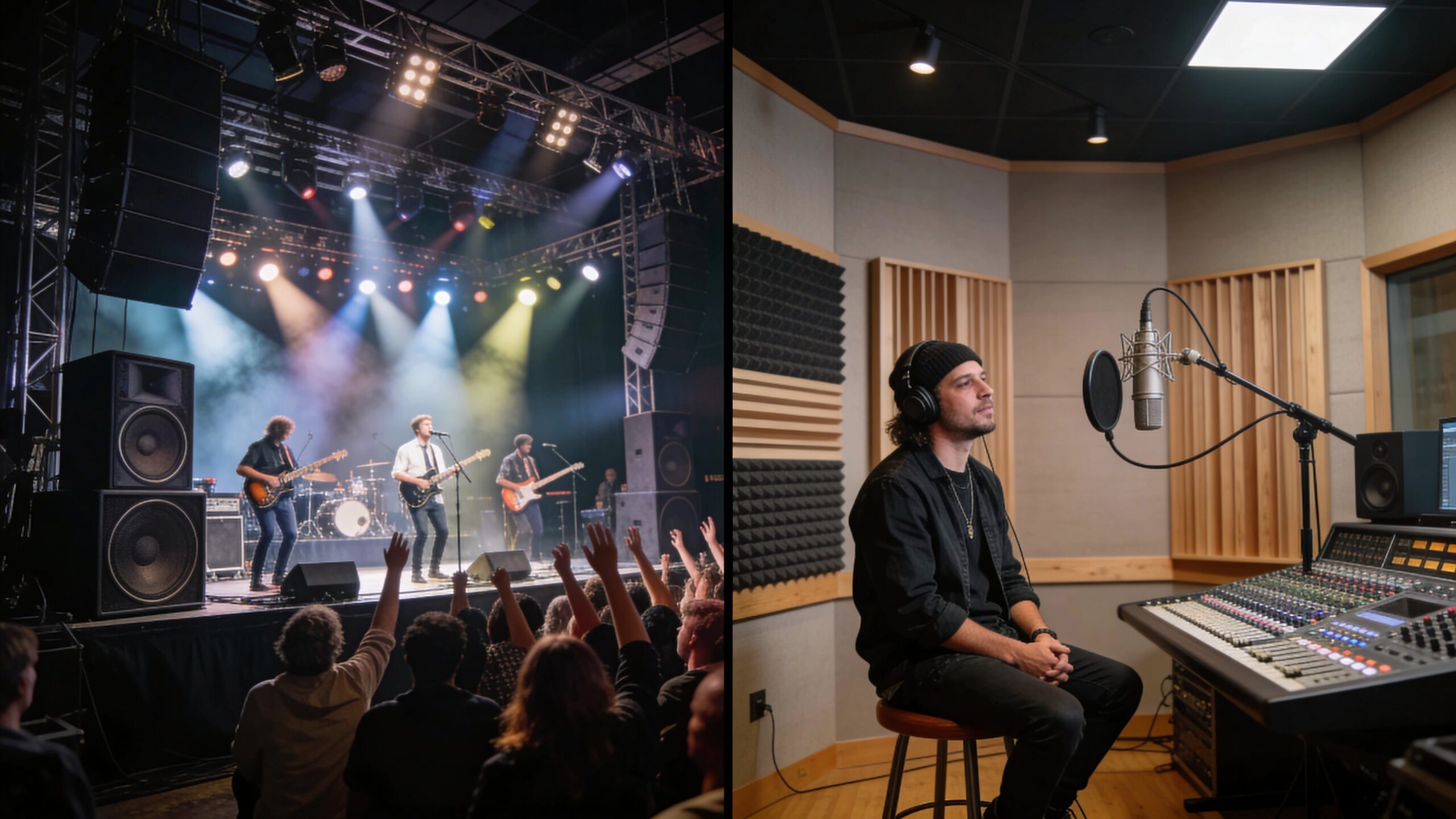
Live sound and studio sound may share the same instruments, but they operate in entirely different worlds. On stage, every note must cut through the air with clarity and energy, shaped by the room, the crowd, and the moment. Musicians and engineers prioritize projection, durability, and immediacy, building systems that translate performance into something powerful and immersive. Microphones, amplifiers, and speakers work together to deliver sound that feels alive, even in unpredictable environments. In the studio, the focus shifts from impact to precision. Every tone is captured, refined, and sculpted with control over acoustics, placement, and processing. Instead of battling a space, engineers shape it, using isolation, monitoring, and detailed signal chains to achieve balance and depth. The same instrument can sound dramatically different depending on whether it’s filling a venue or sitting perfectly in a mix. Understanding these differences helps musicians choose the right gear, techniques, and setups for how and where they create sound.
A: Live focuses on projection; studio focuses on precision and control.
A: Some gear overlaps, but optimization differs by environment.
A: Studio environments allow isolation and detailed editing.
A: No, they lack the power and durability for live environments.
A: Microphones picking up amplified sound in a loop.
A: Yes, most musicians and engineers work across both.
A: Live requires fast decisions; studio allows more time and control.
A: Critical in both, but controlled in studios and variable live.
A: Yes, with reverb, crowd simulation, and mic techniques.
A: Combining live performance capture with studio processing.