
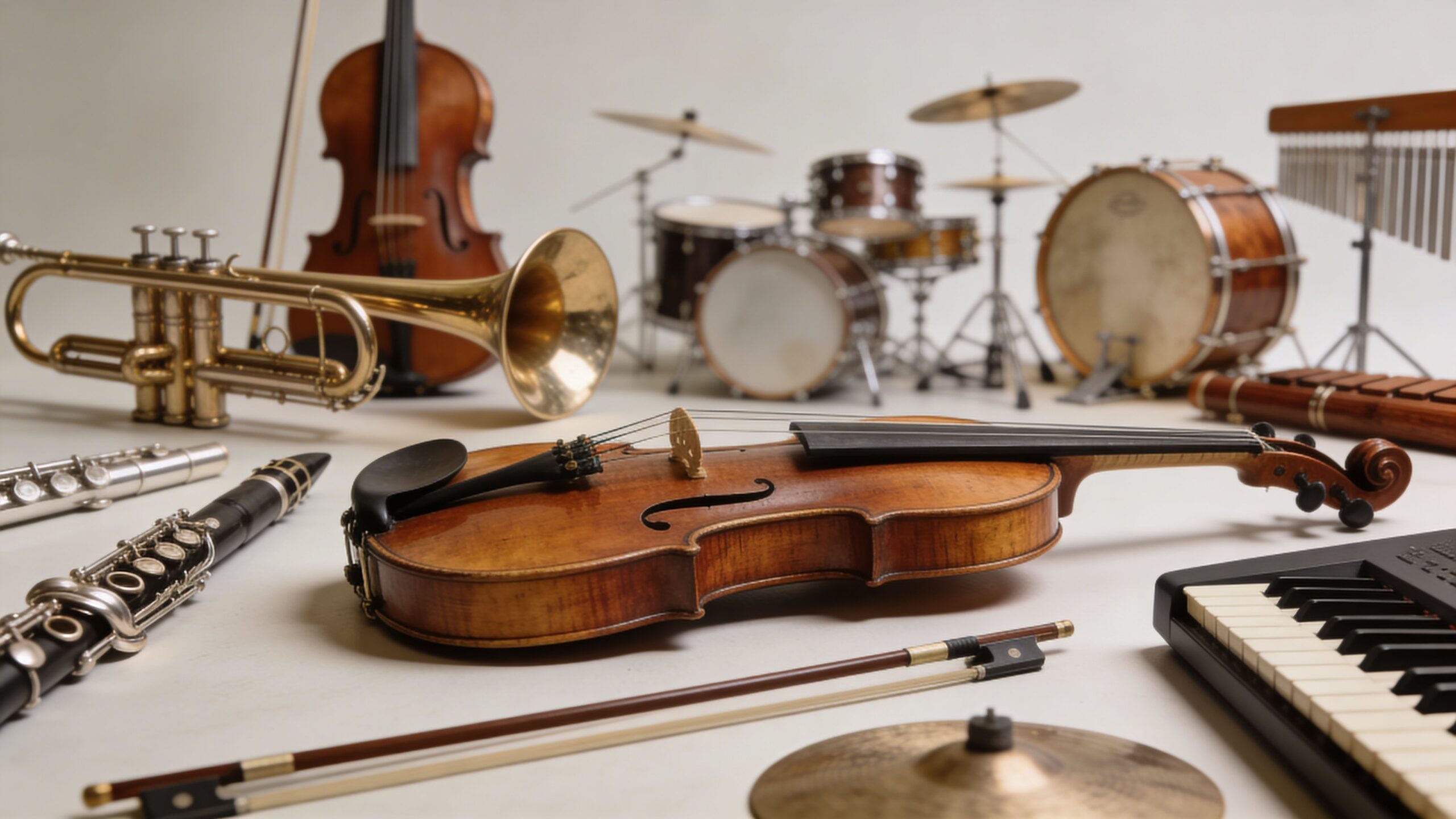
Music theory becomes far more exciting when it is explored through the distinct voice of each instrument family. Strings reveal how melody and harmony can sing through tension, resonance, and phrasing. Woodwinds uncover the color of breath, articulation, and tonal shading. Brass brings power, balance, and harmonic strength into focus, while percussion turns rhythm, pulse, and texture into the foundation of musical movement. Keyboards and plucked instruments connect theory to shape, spacing, and chord design in ways that feel immediate and visual. Instead of treating theory as abstract rules on a page, this approach shows how musical ideas come alive through the character of the instruments themselves. This page is designed as a gateway into that world, helping readers understand how scales, intervals, chords, rhythm, dynamics, and form behave across different families of instruments. Whether someone is curious about orchestral sections, band instruments, folk traditions, or modern setups, these categories make theory feel more practical, expressive, and memorable. It is a richer way to see not just how music is written, but why each family gives theory its own sound and personality.
A: The keyboard shows notes in a clear line, making intervals and chords easier to visualize.
A: Yes, strings often rely more on spatial patterns and ear training, while winds connect theory to fingering and breath.
A: Absolutely, because rhythm, subdivision, meter, and form are core parts of theory.
A: It is an instrument that sounds a different pitch than the note written on the page.
A: Brass instruments naturally produce overtone-based pitches, so harmonic listening matters from the start.
A: Yes, the same interval or chord can feel brighter, darker, softer, or more dramatic depending on timbre.
A: Keyboards are often the easiest for harmony, but every family can teach it in a useful way.
A: Yes, range changes voicing, register choice, and how melodies are written or heard.
A: Yes, they add valuable perspectives on tuning, rhythm, ornament, and sound production.
A: It makes musical ideas feel practical, memorable, and directly connected to real playing.