Begin With Technique, Not a Genre Label
Genre can point you toward an electric guitar, but the way your hands create sound is a better guide. Two rock players may need opposite instruments: one attacks hard in lowered tunings, while the other plays clean arpeggios and bends with a light touch. Body shape, scale length, neck geometry, pickups, bridge design, and controls should support those physical and sonic habits. Define the sounds you use, the techniques you practice, and the environments where you perform. Then choose the guitar that makes those tasks direct instead of choosing a silhouette and trying to adapt afterward.
A: It can cover many, but the best choice should excel at your highest-priority sounds.
A: No. They can sound excellent, though noise and lower output require management.
A: It feels softer at equal gauge, but neck shape and setup remain decisive.
A: Players who use large pitch changes enough to justify its setup routine.
A: No. Their resonant character appears in blues, rock, indie, and other styles.
A: Not automatically; moderate output can improve low-string definition.
A: It affects chord feel, action, and bending, so test it through real techniques.
A: They cannot correct uncomfortable geometry, unstable hardware, or bad fretwork.
A: Use a familiar clean baseline, then add your normal amount of gain and effects.
A: Real songs feel direct, comfortable, and expressive without constant compensation.
Map Your Core Sounds Before Shopping
List three sounds you need without naming a guitar model: perhaps bright clean rhythm, warm sustained lead, and tight distorted riffing. Note how much gain, compression, and effects normally shape each sound. A pickup cannot be judged apart from the amplifier and signal chain, but it establishes the raw attack, output, noise behavior, and frequency balance that the rest of the rig receives. Identify which sound must be excellent and which only needs to be usable.
A session-minded player may prioritize broad switching, while a punk rhythm guitarist may prefer one forceful bridge pickup and a reliable volume control. Versatility has value when the controls remain intuitive. Features that are never used add cost and can place switches where the picking hand accidentally hits them.
Choose Pickups for Attack, Output, and Noise
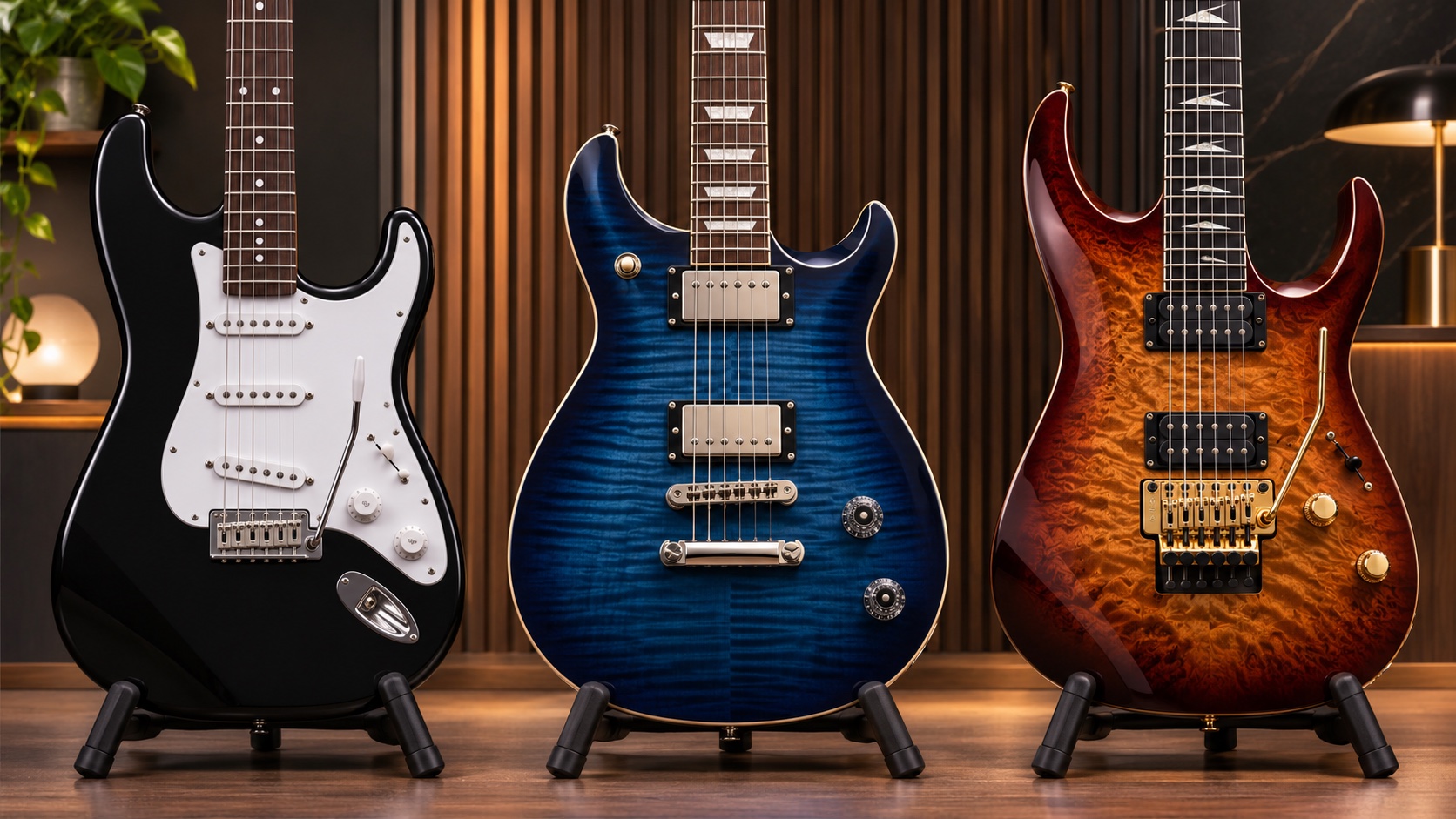
Traditional single coils deliver quick attack, open treble, and detailed response to pick angle. They excel at funk, country, surf, blues, indie, and layered clean arrangements. Their familiar hum becomes more obvious with high gain or electrically noisy rooms. Humbuckers cancel much of that hum and usually provide a thicker midrange, greater output, and smoother top end, making them natural partners for rock, metal, jazz, and singing lead tones. P-90-style pickups sit between those families in feel: broad and muscular but still immediate, with single-coil noise. Active pickups can offer consistent high output, extended clarity, and strong noise performance, though they require a battery and feel different under dynamic hands. HSS and HSH layouts combine families. Coil splitting expands color but usually produces a leaner version of a true single-coil voice rather than an exact replacement.
Match Scale Length to Tension and Tuning
A common 25. 5-inch scale feels firm and articulate with standard strings, helping low notes remain defined. It suits crisp rhythm, alternate tunings with suitable gauges, and players who like resistance. A 24. 75-inch scale feels softer at the same gauge, bringing frets closer and making bends easier. Twenty-four-inch instruments reduce reach further and can be exceptionally comfortable for smaller hands or players who enjoy a loose, expressive feel.
Scale choice interacts with tuning and string gauge. Lowering pitch reduces tension, while heavier strings restore some firmness. Before buying, test the tuning and gauge you intend to use. A guitar that feels ideal in standard tuning with light strings may become vague when dropped several steps. Multiscale designs address differing string needs but introduce angled frets that should be tried rather than assumed comfortable.
Select a Neck That Supports Your Left Hand
Neck thickness is not a ranking of speed. A thin neck may help a thumb-behind position and rapid reach, while a moderate or fuller profile can support the palm and reduce gripping for some players. Nut width controls spacing near first position; fingerboard radius influences the relationship between chord comfort and high bends.
Flatter boards generally allow lower action and wide bends, while rounder boards can feel natural for chord-focused hands. Play the motions that define your style. Use thumb-over blues shapes, wide stretches, barre chords, legato, and bends rather than running a generic scale.
Check access where the neck joins the body. A sculpted heel helps high-register work, while a traditional joint may be irrelevant to a rhythm player. Fret size also matters: tall frets facilitate bending but reveal excessive pressure by pulling notes sharp.
Decide Between Fixed Bridge and Vibrato
A fixed bridge offers straightforward restringing, stable alternate tunings, and direct adjustment. It is often the best partner for heavy rhythm, frequent tuning changes, slide, or players who simply do not use pitch effects. A traditional synchronized vibrato enables subtle shimmer, chord dips, and expressive bends while remaining reasonably serviceable. Its stability depends on nut condition, string installation, spring balance, and technique.
Double-locking systems support dramatic pitch changes and can be extremely stable once set, but restringing and tuning adjustments require a process. They are worthwhile for players whose vocabulary depends on deep dives, flutters, and aggressive bar work. They are unnecessary friction for someone who changes from standard to drop tuning between songs. Choose the bridge for actual gestures, not for the possibility that it might be useful someday.
Relate Body Construction to Feel and Response
Solid-body guitars resist feedback and cover the widest range of stage volumes. Chambering can reduce weight and add acoustic liveliness without producing the behavior of a full hollow body. Semi-hollow guitars combine a resonant response with a center block that improves control under amplification. Fully hollow electrics offer air, warmth, and touch sensitivity but require thoughtful placement and gain management. Body wood is only one contributor among construction, mass, bridge, neck joint, pickups, and setup. Evaluate the whole instrument. Pay close attention to weight distribution. A light body with a heavy neck can dive; a heavy single-cut may sound satisfying but strain the shoulder. Contours, edge shape, and control placement affect a three-hour rehearsal more than a marketing description of resonance.
Fit the Guitar to Specific Musical Roles
For clean funk and pop, seek quick transient response, comfortable muted rhythm, and pickup combinations that retain detail. Blues players may prioritize dynamic volume cleanup, easy bends, and a neck pickup that stays articulate. Classic-rock players often appreciate medium-output humbuckers or P-90s, while modern metal benefits from defined low strings, stable tuning, and pickups that remain clear under saturation. Jazz does not require a hollow body; it requires the warm, responsive sound and physical feel the player prefers.
Country does not require one bridge pickup, though a crisp attack helps its vocabulary. Ambient players should consider how pickup noise and tremolo behavior interact with compression and long delays. Let genre suggest tests, then let the results decide.
Consider Recording and Stage Logistics
In recording, electrical noise, intonation, and repeatable controls become obvious. Shielding, hum-canceling positions, and smooth potentiometers save time. A guitar with lower-output pickups may layer more cleanly, while a high-output instrument can drive an amplifier without pedals.
Check whether volume changes preserve treble and whether tone controls offer a useful range instead of becoming dull immediately. Stage use adds strap balance, control visibility, cable security, and fast tuning. If songs require multiple tunings, two fixed-bridge guitars may be more practical than one complex instrument.
Players who sing should verify that switch locations do not invite accidental changes. Touring also favors common parts, durable finishes, and a case that protects the headstock and bridge.
Audition Through a Neutral Signal Chain
Bring your own amplifier when practical or use a familiar clean platform. Begin with effects off and equalization centered. Match volume carefully because louder sounds usually seem better. Play clean before adding gain, then use the amount of distortion you truly employ. Listen for string-to-string balance, note separation, unwanted noise, and whether the guitar responds when your attack changes.
Adjust the strap and play standing. Use the upper frets, palm mute at the bridge, operate every control, and sit with the guitar in your normal position. Test tuning stability after bends or vibrato use. Record a short phrase from each candidate with identical settings. The purpose is not to discover an abstract best tone; it is to see which guitar turns your musical intentions into sound with the fewest corrections.
Choose a Platform You Can Maintain
Some players enjoy modifying pickups, bridges, and wiring, while others want a finished tool. Widely used designs provide abundant replacement parts and technician familiarity. Proprietary hardware can be excellent but may be harder to replace quickly. Check truss-rod access, bridge adjustability, battery location, and whether the intended string gauge fits the nut and tuners. A setup should be part of the purchase plan. Relief, action, intonation, pickup height, and tremolo balance work together. Ask the technician to optimize for your tuning, gauge, and attack rather than applying a generic low-action target. Keep the original parts if modifications are made; they help with troubleshooting and resale.
Make the Decision With Real Songs
Finish the audition by playing one song that represents rhythm, one that represents lead or melody, and one that uses your most demanding technique. A guitar may excel at isolated exercises yet feel cumbersome through an arrangement. Notice whether you stop thinking about the instrument and begin thinking about timing, phrasing, and dynamics. That shift is strong evidence of fit.
Choose the candidate that supports the highest-priority sound, stays comfortable, and handles your real tuning and performance routine. Appearance matters because it invites connection, but it should reinforce function. The right electric guitar does not dictate a style. It gives your hands and signal chain a dependable starting point from which that style can become more personal.
Use Amplifier Interaction as Part of the Fit Test
A guitar that seems overly bright through one amplifier may become perfectly balanced through another, so repeat the audition through equipment similar to your own. Tube, solid-state, and modeling amplifiers respond differently to pickup output and volume changes. Set gain low enough to hear the guitar’s attack, then raise it to performance level.
If the low strings lose definition or the top end becomes tiring, try pickup-height and amplifier adjustments before rejecting the instrument. Effects also reveal practical differences. Compression exaggerates single-coil noise, long delays expose tuning problems, and heavy distortion tests note separation.
Run only the effects central to your style; a giant demonstration preset can make every candidate sound alike. Note whether the guitar retains a recognizable response when the signal chain becomes complex.
Account for Right-Hand Ergonomics
Players often analyze the neck while ignoring where the picking hand lands. Bridge shape, pickup height, control placement, and body contour determine whether palm muting, hybrid picking, and volume swells feel natural. Rest the hand as you would during a full song. Sharp saddle screws, a tall pickup ring, or a volume knob under the picking arc can become a repeated irritation.
Try the guitar both high and low on the strap because angle changes the approach to the strings. Confirm that the output cable does not interfere with the leg or strap. These details rarely appear in genre guides, yet they determine whether a technically suitable guitar feels transparent during performance.
Revisit Priorities After the Audition
Store trials often reveal that an assumed requirement is less important than expected. You may discover that a moderate-output pickup feels more expressive than a hotter one, or that a fixed bridge frees the right hand. Update the priority list with evidence rather than defending the original plan. Before buying, name the winning guitar’s three concrete advantages in complete sentences. If those advantages describe your technique, sound, and performance routine, the choice is grounded. If they describe only finish and reputation, audition again.