Two Close Relatives With Different Physical and Musical Centers
Violin and viola share four strings, a fretless fingerboard, an upright bridge, and much of the same bowing vocabulary, but they ask the player to think in different ranges and weights. The violin is standardized around a compact full-size body, tuned G–D–A–E, and prized for brilliance and carrying power. The viola varies widely in dimensions, replaces the violin’s E with a low C, and produces a darker inner voice that rewards broader bow contact. Choosing between them is not a question of easier versus harder. It is a choice between physical proportions, ensemble functions, notation systems, and colors.
A: No. Its tuning, proportions, strings, bow response, notation, and musical role are distinct.
A: Neither universally; correct fit, instruction, and attraction to the sound matter more.
A: The finger patterns transfer, but alto clef requires dedicated reading practice.
A: Yes. Viola bows are generally heavier and stronger to engage thicker strings.
A: No. String length, neck, ribs, and body outline can differ substantially.
A: Sometimes, but width and geometry often call for separate fitted supports.
A: Lower tuning, larger construction, thicker strings, and different resonances shape its color.
A: They may sound less brilliant, but focused violas can project powerfully in their range.
A: Yes, with a properly sized instrument and teacher experienced in young violists.
A: Favor the voice, role, and physical response that make sustained practice appealing.
The Tuning Moves the Entire Register Down
A violin’s strings are tuned G3, D4, A4, and E5. The viola uses C3, G3, D4, and A4, preserving fifths but extending below the violin at the expense of its highest open string. Three shared pitches make transfers intuitive, yet the low C changes resonance, repertoire, and the way a player organizes the hand.
The viola’s range overlaps the violin’s middle register and the cello’s upper territory. This position gives it unusual flexibility: it can reinforce harmony, carry a warm melody, or connect bright upper strings to the bass. The violin more often occupies the top line, where articulation and pitch definition remain exposed.
Body Length Is Standardized Differently
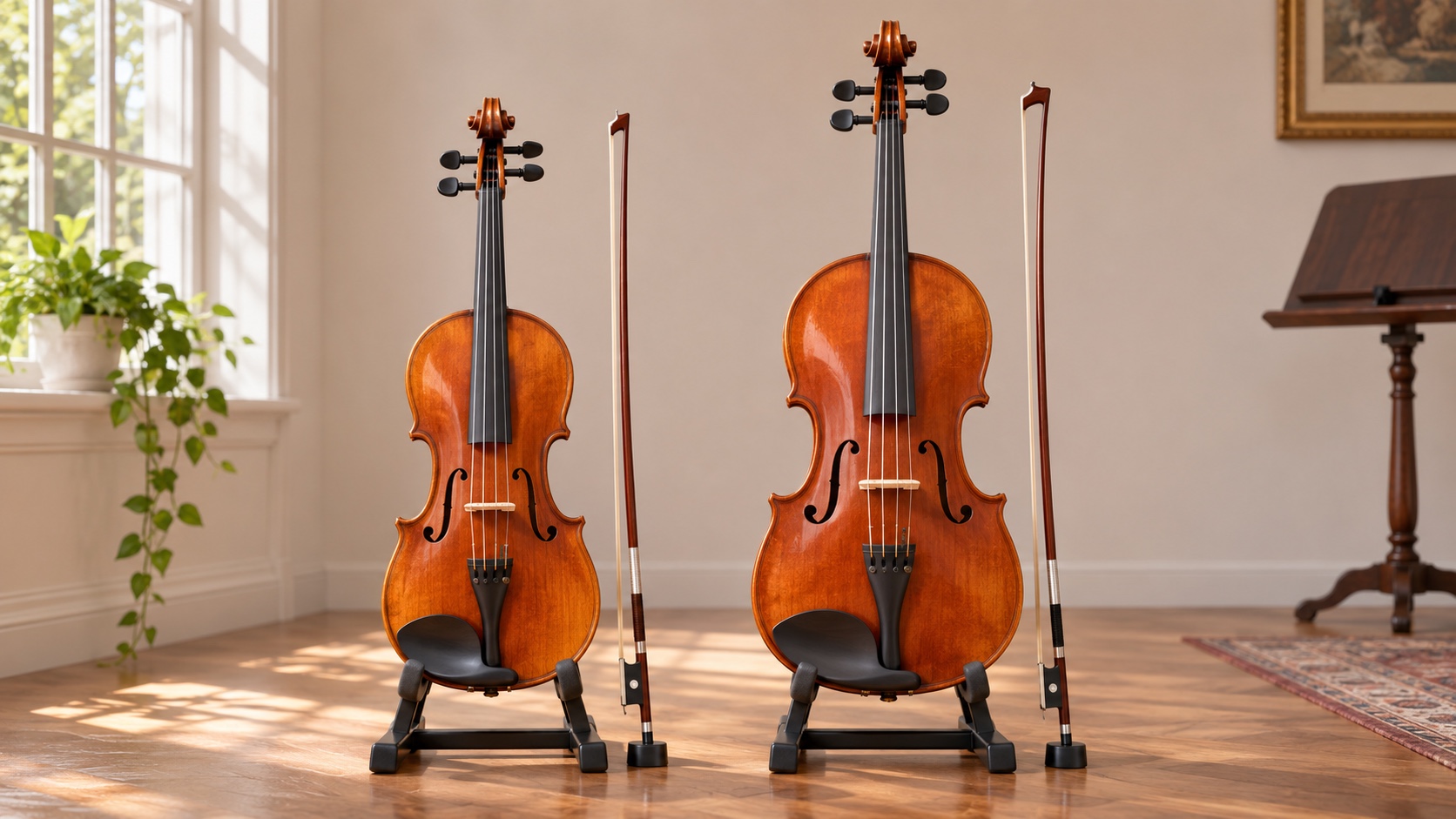
A full-size violin body is roughly fourteen inches, while adult violas commonly range from about fifteen to sixteen and a half inches or more. Viola size is named in inches rather than a single universal full size. Makers alter outline, rib depth, and arching because an acoustically ideal instrument for the low C would be larger than most people could play beneath the chin. Two sixteen-inch violas can feel unrelated. Stop length, neck length, upper-bout width, and rib height affect reach. A player should never choose by body length alone. Measurement narrows the field; playing position decides whether the design fits.
String Length Changes Spacing and Tension
The viola usually has a longer vibrating string length, spreading notes farther apart in first position. The left hand must open more and travel a greater distance during shifts. Some modern ergonomic violas preserve a generous body volume while shortening the string length, which can protect smaller hands without giving up all low-register depth.
String composition and gauge also shape tension. Viola sets are frequently mixed to balance a slow C string with a clear A.
Violin sets tend to feel more uniform across the smaller body. Players moving between instruments need time to recalibrate finger spacing rather than relying on visual landmarks.
The Viola Bow Is Built for More Mass
Viola bows are generally a little heavier, with a broader frog and enough strength to engage thicker strings. The bow must transfer energy into a larger system while remaining agile. A violin bow can produce sound on a viola, but it may feel underpowered on the C string or encourage excess hand pressure. The player uses weight efficiently through arm balance, contact point, and bow speed. Pressing is not the solution. A stable viola bow allows the hair to stay connected during long strokes and recover cleanly in articulation. Bow selection matters almost as much as instrument size.
Sound Begins With Different Attack Speeds
Violin strings respond quickly and can produce a bright, focused onset with modest travel. The E string adds brilliance that carries above an ensemble. Viola strings need a slightly more patient start, especially on C, where thickness and body resonance take time to organize. The reward is a broad, textured sound with a human, speaking quality.
That difference is relative, not absolute. A fine viola can respond immediately, and a dark violin can sound rounded. Technique, strings, setup, room, and player dominate simplistic labels. Listen for how the note begins, blooms, and carries rather than relying only on “bright” and “warm.
Left-Hand Technique Requires Wider Planning
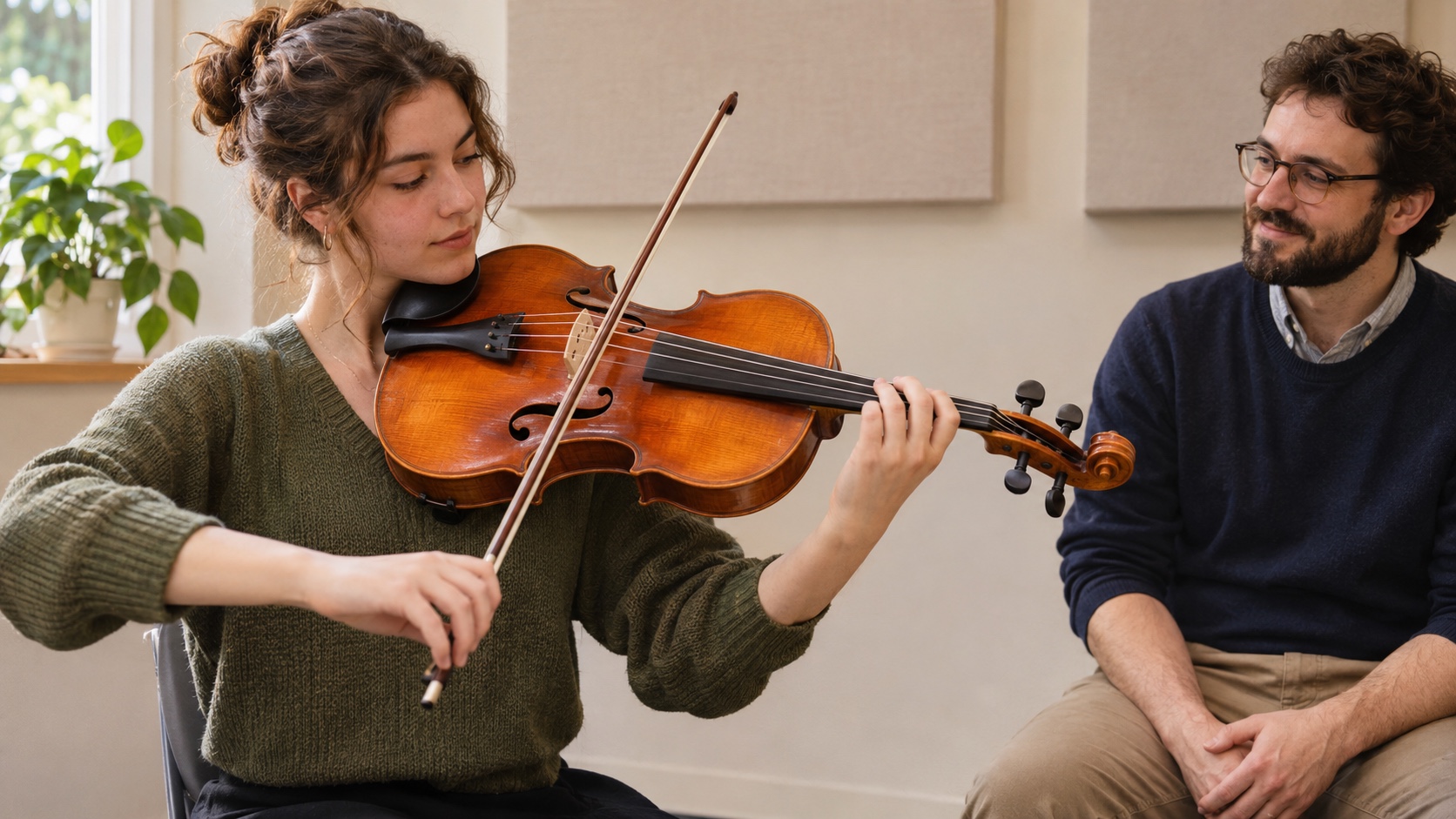
Violin repertoire often uses compact spacing, rapid passagework, and extended high positions. Viola shares those demands but adds larger intervals under the hand. The first finger must release between notes, the thumb must remain mobile, and shifts should move the arm rather than stretch a locked hand. Players with small hands can succeed on viola when the instrument is fitted intelligently. Rotating the forearm, adjusting chinrest height, and choosing an appropriate string length are more effective than forcing reach. Pain or numbness indicates a sizing or technique problem, not dedication.
Right-Hand Technique Uses Broader Contact
Violinists often exploit quick bow speed, narrow contact points, and a brilliant upper-string edge. Violists learn to wait for the string, use the natural weight of the arm, and maintain enough bow hair to keep the core alive.
The bow may travel a little more slowly on low strings while staying flexible at changes. Crossings also feel broader because of string diameter, bridge geometry, and instrument scale.
A violist must clear adjacent strings without lifting unnecessarily. Good technique appears grounded, not heavy: the sound opens while the shoulder and thumb remain free.
Clefs Reflect Each Instrument’s Useful Range
Violin music is written primarily in treble clef. Viola uses alto clef, with middle C on the center line, because this keeps much of its range within the staff. Treble clef appears when the viola climbs high. Reading both systems becomes an essential part of fluent viola playing. Alto clef is not an obstacle so much as a map aligned to the instrument. Transferring violinists should learn landmarks and intervals rather than translating every note. Daily sight-reading makes the new clef automatic sooner than memorized repertoire alone.
Orchestral Roles Shape the Experience
Violins are divided into first and second sections. First violins frequently carry high melodies and exposed brilliance; seconds combine melody, rhythm, and inner harmony. Violas sit inside the texture, connecting upper voices to cellos and basses. Their parts can define harmonic color and rhythmic motion even when audiences do not notice the line separately.
Modern orchestral writing gives viola substantial solos and athletic passages, while historical parts range from sustained support to intricate counterpoint. Players who enjoy listening across the ensemble may find the inner role deeply satisfying. Those drawn to soaring top lines may prefer violin.
Chamber Music Gives Viola a Distinct Voice
In a string quartet, the viola is the single middle instrument between two violins and cello. Its attacks and color can unify the group, and its entrances often redirect harmony. The first violin may lead melodic contour, but successful chamber playing depends on conversation rather than hierarchy. Viola parts can be rhythmically exposed and harmonically surprising. The instrument must project without abandoning warmth. Quartet experience quickly teaches a player to adjust vibrato, bow contact, and articulation to match different partners.
Solo Repertoire Tells Different Stories
The violin possesses a vast solo literature spanning Baroque sonatas, Romantic concertos, virtuoso showpieces, fiddle traditions, and modern works. Its bright register and technical agility support spectacular projection.
Students encounter abundant editions, recordings, and teaching traditions. The viola repertoire is smaller but rich, including distinctive concertos, sonatas, transcriptions, and twentieth-century works that explore its introspective range.
Violists also borrow music from cello, clarinet, and violin with thoughtful adaptation. A player may enjoy the sense of discovering a less crowded canon.
Fiddle and Contemporary Styles Welcome Both
Violin dominates many folk traditions because of its carrying power and historical role. Its E string supplies brilliant ornaments and high leads. Viola can add a low rhythmic voice, drones, harmony, and a darker solo color that distinguishes an arrangement. Looping, amplification, improvisation, and studio layering expand both roles. A five-string instrument combines violin and viola ranges but introduces compromises in body, spacing, and string balance. It is a useful separate choice, not a complete replacement for either traditional instrument.
Physical Comfort Should Guide the Choice
Hold each instrument with a professional fitter. Check left-arm reach, fourth-finger placement, shoulder level, jaw pressure, and bow access at the tip. The viola’s extra length, width, depth, and weight accumulate. A difference that feels trivial for one minute may become important after an hour.
Chinrests and shoulder supports can improve alignment, yet they cannot rescue an instrument that is fundamentally too large. Smaller violas with strong design deserve serious consideration. Relaxed movement produces a better sound than extra body volume controlled through tension.
Switching Between Them Requires Deliberate Recalibration
A violinist moving to viola must widen spacing, adjust bow engagement, learn alto clef, and hear the A string as the top of the system. A violist moving to violin must lighten and quicken responses without losing core. Several minutes of scales and open strings help reset the body before repertoire. Doubling can strengthen listening and flexibility. It can also create confusion if the two instruments are poorly fitted or practice is rushed. Keep separate bows, document support setups, and practice transitions instead of assuming similarity will handle everything.
Beginning Opportunities Differ by Community
School programs often need violists and may offer rentals, scholarships, or faster access to ensembles. Violin programs may provide a larger peer group and more local teachers.
Availability should inform the decision without becoming the sole reason to choose an instrument. Meet the likely teacher and listen to both instruments live.
A student’s attraction to the sound matters because it sustains practice. The best logistical opportunity still needs a genuine musical connection.
Choose the Voice You Want to Build
Play a simple melody on both instruments, then listen while an experienced musician performs. Notice whether the violin’s direct brilliance or the viola’s layered middle color holds your attention. Consider ensemble position, notation, repertoire, and how the body responds after an extended trial. Neither instrument is a fallback. Each rewards a lifetime of precise hearing and coordinated movement. The right choice is the one whose range and resistance make you curious enough to return every day.
Practice Materials Transfer Unevenly
Scales, arpeggios, rhythm studies, and many bowing exercises can serve both instruments after pitches and spacing are adjusted. Etudes written specifically for viola often address broad string crossings, C-string articulation, alto clef, and the particular reach of the instrument. Violin materials may move higher sooner and rely on the E string’s brilliance. A teacher should choose studies for the developing weakness rather than assuming every page transfers unchanged.
Transcriptions also require judgment. Moving a violin piece down an octave may create awkward resonance or erase its intended line, while playing it at pitch can push viola into a different color. Good adaptation respects the voice of the destination instrument.
Maintenance Reflects Different Loads
Both instruments need stable humidity, clean strings, healthy bridges, periodic bow rehair, and prompt seam repair. Viola bridges, strings, cases, and shoulder fittings must match less-standardized dimensions, so replacements may require more careful sourcing. A generic violin accessory should never be forced onto a wider body. Record string length, body length, bridge measurements, and support models. Those details make service and travel replacements easier. Violin owners benefit from the same documentation, even though standardized sizing makes shopping appear simpler.
Respect the Shared Family and the Real Differences
Good violin and viola technique share relaxed alignment, accurate pitch, and thoughtful bow control.
Their distinct dimensions and voices then turn those foundations into different musical identities.