A First Viola Must Produce a Real C String Without Overloading the Player
Viola selection asks for a balance that violin shopping can avoid: a larger resonating body supports the deep C string, yet every extra fraction of an inch changes reach, weight, and bow leverage. Beginners need an instrument that is correctly sized, professionally adjusted, stable in tuning, and responsive enough to reward a relaxed stroke. The best student models use traditional spruce-and-maple construction, functional fittings, and sensible outfit components, but model names are only a starting point. A teacher or viola specialist should match the exact instrument to the player’s arm, hand, shoulder, and musical setting.
A: It is a common adult size, but violas have no single standardized full-size measurement.
A: No. Choose the smallest comfortable instrument that supplies the needed response and depth.
A: Some small programs use that approach, but purpose-built fractional violas may respond more convincingly.
A: It controls left-hand spacing and can differ between instruments with similar body lengths.
A: Yes. Appropriate weight and strength help engage the thicker, slower-responding strings.
A: Its mass requires coordinated bow speed and weight, while setup and strings also influence response.
A: Yes. Many preserve acoustic volume while reducing reach or upper-bout interference.
A: Certainly, especially when it prevents tension and still provides a satisfying voice.
A: Expect a properly fitted viola, suitable bow, secure case, rosin, and a workable support system.
A: Judge the entire instrument; a grand C cannot compensate for a weak or harsh upper range.
Viola Size Is a Musical and Physical Decision
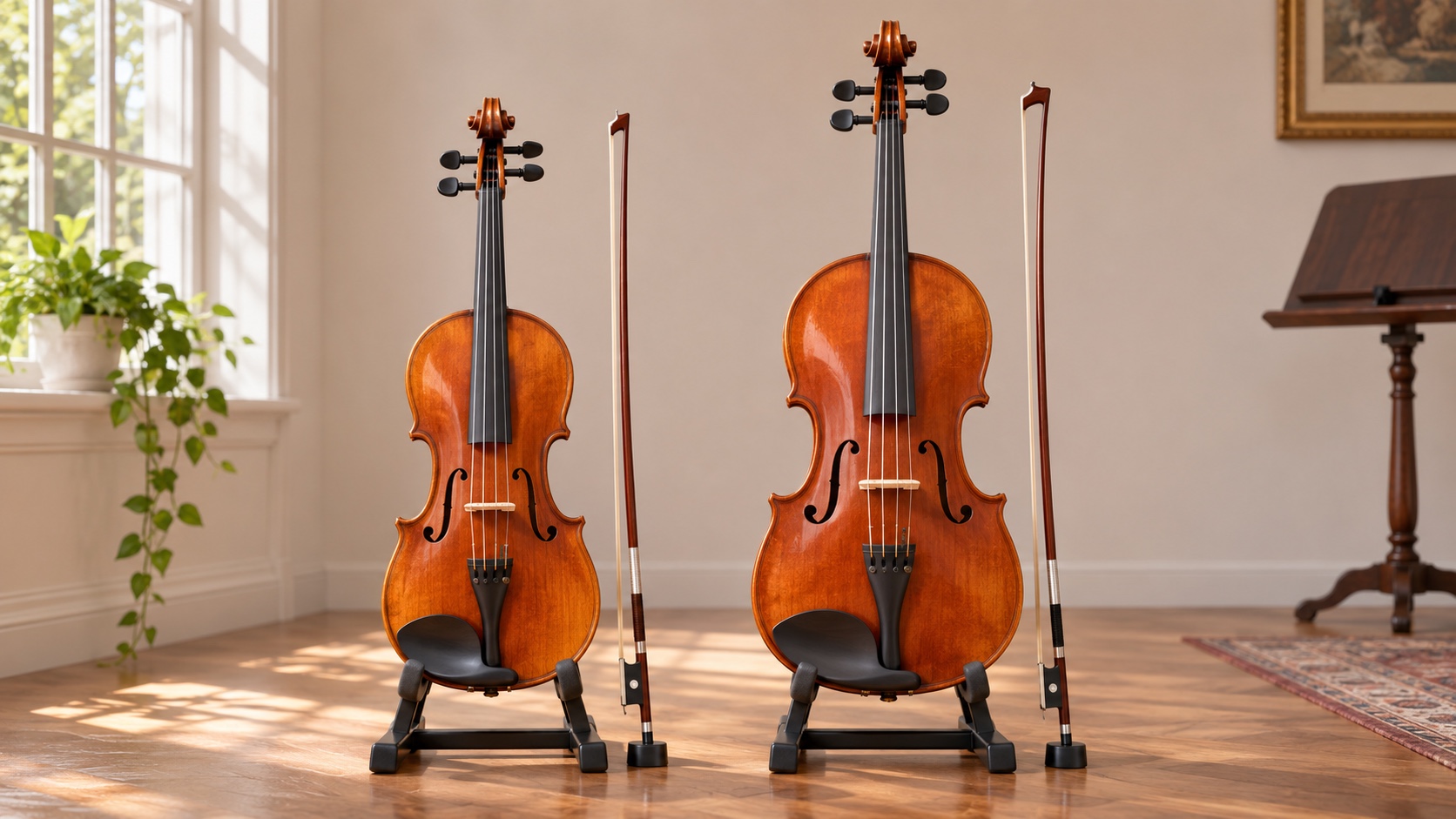
Unlike violin, viola has no single standardized full size. Body lengths for adult instruments commonly range from about fifteen to more than sixteen and a half inches, with many fractional and youth options below that. Two violas with the same body length may have different necks, stop lengths, upper bouts, and rib depths, so they can feel surprisingly different. The player should reach first position without locking the elbow, raising the shoulder, or pulling the instrument inward with the jaw. The left hand must open naturally around the neck, and the bow arm must reach the tip without twisting the torso. A powerful C string is not worth chronic tension.
Yamaha AVA5: A Coherent Beginner Outfit
Yamaha’s AVA5 student viola is designed as the viola counterpart to its established student string line. Current manufacturer information describes a hand-carved spruce top, maple back and sides, aged tonewoods, and outfit-oriented construction intended for beginning players. The integrated package can simplify the first purchase when supported by a dealer who performs final setup.
Verify the exact size, case, bow, and regional specifications because packages can vary. The model’s greatest attraction is predictable baseline construction rather than a guarantee that every body will fit. Compare it with at least one alternative shape, especially for a player near the limit of comfortable reach.
Yamaha AVA7: More Expression for a Committed Student
The AVA7 is positioned for advancing students who need greater response and tonal development. It may suit an adult beginner planning sustained study or a younger player who has already demonstrated commitment on a rental.
Extra tonal headroom can help the student learn how bow speed and contact point change the viola’s dark middle voice. Do not pay for the step-up solely to avoid upgrading later.
A growing child may need a different body length soon, and an oversized higher model is still the wrong instrument. Let the teacher decide whether the player can use the added response and whether the size will remain appropriate.
Eastman VA100: Workshop Construction Across Useful Sizes
Eastman’s Samuel Eastman student line is widely represented in string programs, and its viola counterpart offers carved spruce and maple construction with ebony fittings in multiple sizes. Dealers often assemble the final outfit, allowing them to choose bow, case, strings, and shoulder support for local students. This can produce a more thoughtful system than a sealed generic package.
Ask the shop to explain the setup and identify the string length, not just the body measurement. Compare several examples if inventory allows. Wooden instruments vary, and the strongest value may be the individual viola with the quickest C-string response rather than the prettiest back.
Franz Hoffmann Viola Outfits: Accessible Shop Preparation
Franz Hoffmann student viola lines emphasize traditional materials, practical fittings, and workshop adjustment within complete outfits. A specialist retailer’s trial and trade-up structure can be particularly useful for families navigating size changes. Access to phone or in-person fitting support adds value beyond the listed components. Current model names, contents, and availability can change, so confirm what is actually included. Check whether the bow is viola-weight, whether the case fits securely, and whether the shoulder rest matches the body. A violin bow or loose universal case is not an equivalent substitute.
Quality Rentals Are Often the Best Youth Option
A rental program can provide a well-adjusted small viola now and exchange it as the player’s reach changes. Maintenance and damage coverage reduce surprises during school use, while accumulated credit may support a later purchase. This avoids buying an underpowered fractional instrument that has little resale market.
Not every rental program is equal. Ask whether small instruments are true violas or restrung violins, which strings are installed, how bows are maintained, and how quickly repairs or exchanges are handled. A responsive small-bodied viola can be a sophisticated design rather than a compromise.
The C String Exposes Weak Construction
Play long bows on the open C string at soft and moderate dynamics. The note should begin without a crushing attack and retain a defined pitch beneath its warmth. Slow response, surface noise, or a hollow unfocused sound may indicate an unsuitable setup, strings, or a body that cannot support the low register.
Then cross between C and G. The two strings should feel related rather than requiring a complete reinvention of bow pressure.
A beginner cannot yet draw the maximum voice from a viola, so ask a teacher to demonstrate. Listen from across the room, where low-frequency focus becomes clearer.
String Length Can Matter More Than Body Length
The vibrating string length influences left-hand spacing and tension. Some ergonomic viola designs use a generous body with a shorter string length; others pair a modest body with a longer reach. Players with small hands may tolerate body width but struggle with extended semitone spacing in first position.
Measure and compare rather than relying on a nominal sixteen-inch label. Play a first-position scale slowly, noting whether the fourth finger lands without the wrist collapsing. The right choice allows accurate spacing while keeping the instrument stable on the shoulder.
Body Shape and Rib Depth Affect the Shoulder
Wide upper bouts can interfere with the base of the thumb or require more reach around the instrument. Deep ribs improve air volume but lift the bow arm and change jaw height. Cut corners, sloped shoulders, and asymmetric modern designs may preserve acoustic volume while improving access. Traditional appearance is not a prerequisite for a genuine viola sound. Ergonomic models deserve an open-minded audition, especially for adults managing injury. Whatever the outline, the case and shoulder support must fit the exact design without pressure or movement.
The Bow Must Match Viola Resistance
Viola bows are generally heavier than violin bows and designed to engage thicker strings. A weak, warped, or overly light stick can make the C string feel slower than it really is. The beginner needs stable tracking and enough strength to produce a core without squeezing the hand. Test straightness, screw function, frog security, and hair condition.
Carbon fiber offers durable consistency for school use, while wood bows vary widely. Play at the frog, middle, and tip on every string. A balanced bow should help the player sustain sound rather than fight gravity.
Strings Can Rescue Balance but Not Bad Geometry
Viola string sets are often mixed to balance response and tension. A shop may choose a particular C string for depth, a different A for clarity, and compatible middle strings.
This is legitimate tailoring, but it should happen after bridge, soundpost, nut, and fingerboard geometry are correct. Fresh strings stretch and settle, so tuning changes are normal initially.
A persistent weak register, wolf, or painful action needs diagnosis. Do not cycle through expensive sets while an open seam or poor bridge fit remains untreated.
Four Fine Tuners Help Early Pitch Control
Beginners benefit from fine tuners on every string, especially when thicker viola strings make small peg movements difficult. Integrated composite tailpieces keep the mechanism light and orderly. Each screw should have travel remaining and clear the top of the instrument.
Pegs still need to work smoothly for larger adjustments. Ask the shop to address slipping or sticking before delivery. Geared pegs can be an excellent accessibility solution, but standard pegs are fully functional when fitted correctly.
Listen for an Even A String, Not Only a Grand C
Shoppers naturally focus on the low register, yet the A string carries exposed melodic work and must avoid a thin, nasal edge. Play a scale across all four strings and listen for continuity. The transition from D to A should preserve body, while the C and G should remain clear rather than woolly. A good student viola offers a family resemblance across registers. Some contrast is expressive, but abrupt changes make bow learning harder. Compare at matched volume because a loud low end can distract from an unbalanced upper register.
School and Orchestra Use Add Practical Requirements
Daily transport calls for durable varnish, a protective case, reliable latches, and comfortable backpack straps. The viola should carry a label inside the case while avoiding visible personal details. A mute, pencil, spare strings, and cleaning cloth need secure storage away from the instrument’s top.
In ensemble, the player must hear articulation amid other instruments. A focused middle register may serve better than a very dark but diffuse voice. Ask the teacher whether the orchestra’s repertoire and room favor extra clarity or warmth.
A Viola-Specific Audition Prevents Violin Assumptions
Tune carefully, play slow bows on C, cross through all strings, and test a one-octave C-major scale. Add a sustained melody on D and A, simple double stops, and a passage that uses fourth finger.
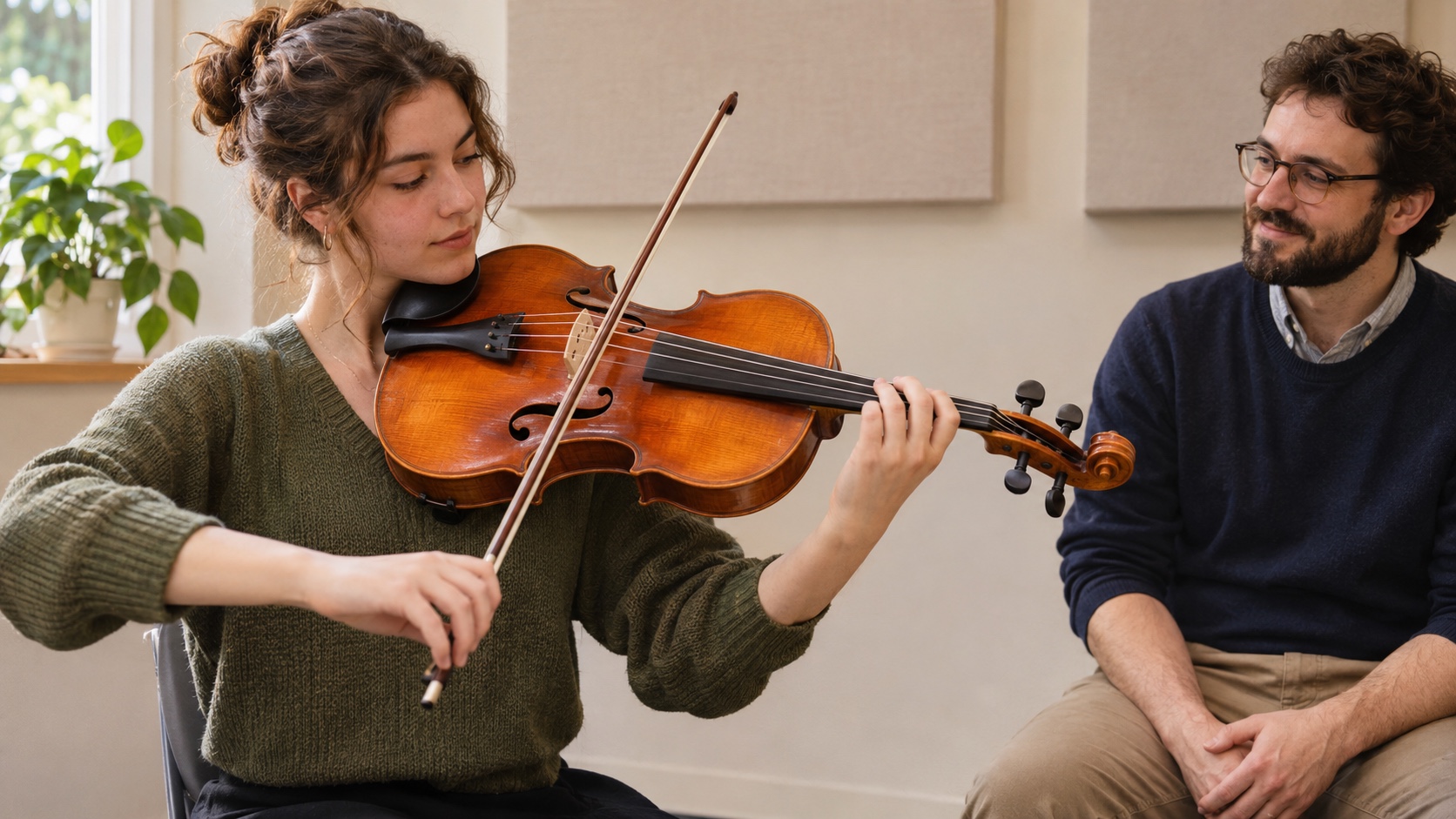
Stand as well as sit, and use the shoulder setup intended for lessons. Repeat the routine on every candidate with the same bow, then have a violist demonstrate.
Record from several feet away. The winning instrument should combine reach, quick response, register balance, and a sound the student wants to hear again.
Budget for Fit and Service
Include a viola bow, shaped support, setup review, strings, case, stand, and maintenance. Because viola ergonomics are individual, chinrest and shoulder-rest fitting can deliver more value than cosmetic upgrades. Rehair and string replacement should be planned rather than postponed until playability collapses.
A used viola can be excellent when a specialist checks seams, neck angle, bridge, soundpost area, and prior repairs. Trade-in policies are helpful for growing players. Spend for a sustainable system, not the largest body or most dramatic varnish available.
Choose the Smallest Viola That Delivers the Needed Voice
Bigger instruments often support a broader low register, but modern design, strings, and setup allow smaller violas to sound remarkably complete. Once added length causes tension, its acoustic benefit becomes irrelevant. The player’s relaxed technique is itself part of the sound. Narrow the field to mechanically sound, correctly sized examples, then allow the student to choose among voices and appearances. A first viola worth buying makes the C string inviting, the A string usable, and tomorrow’s practice physically realistic.
Recheck the Instrument After the First Lessons
Early sessions reveal whether the chosen support slips, the bow feels too weak, or first-position spacing remains tiring. Ask the teacher to inspect posture and listen for uneven response while the return period remains active.
Small fitting changes are normal; recurring strain or an unresponsive C string deserves prompt reconsideration.
Let Comfort Protect the Dark Sound
The viola’s appeal lies in its depth and inner voice, but that character should emerge from a free body and responsive instrument, never from strain.