Two Acoustic Instruments Built Around Different Kinds of Touch
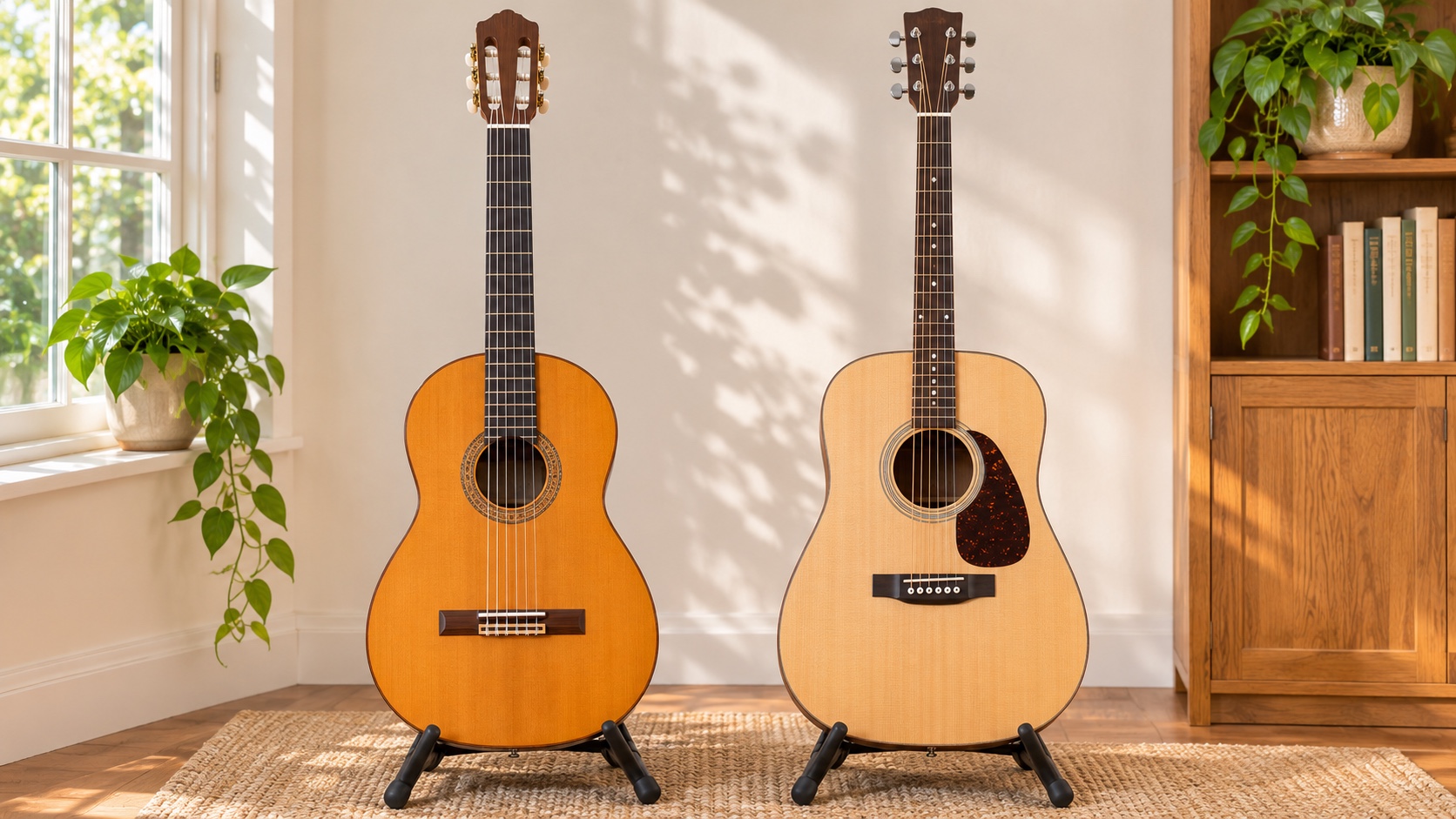
A classical guitar and a steel-string acoustic guitar can share the same familiar outline yet respond like different instruments. The classical design uses nylon strings, a broad flat fingerboard, fan-style bracing, and a light touch to produce a rounded voice with quick color changes. A modern steel-string usually uses a narrower radiused neck, pin bridge, stronger top bracing, and higher-tension metal strings for projection, sustain, and a bright attack. Neither is the advanced or beginner version of the other. Choosing well means matching construction and response to the music, hands, and sound you actually want.
A: Yes. The intended music, physical fit, and teacher’s method should guide the choice.
A: They feel softer, though classical neck width and higher action create different demands.
A: No. Their tension can seriously damage a structure designed for nylon.
A: Not inherently; extra spacing can make clean finger placement easier.
A: Steel-string guitars usually project more strongly, though body and playing style matter.
A: Some do, while many rely on nonadjustable reinforcement and careful construction.
A: It can be used gently, but traditional techniques rely mainly on fingers and nails.
A: Either can record beautifully when its voice complements the arrangement.
A: They can pair nylon tone with a narrower radiused neck for players changing styles.
A: Choose the instrument that makes your preferred articulation comfortable and repeatable.
Strings Create the First Major Divide
Classical sets combine three plain nylon or fluorocarbon treble strings with three bass strings wound over multifilament cores. Their lower tension allows wide vibrato, soft attacks, and substantial changes in tone depending on where and how a fingertip releases the string. Steel-string sets use metal cores and windings at noticeably higher tension. They drive the soundboard harder and preserve more high-frequency energy, creating the crisp definition heard in strumming, flatpicking, and contemporary fingerstyle. The two types are not interchangeable. Steel strings can overload a classical guitar’s top, bridge, and neck, while nylon strings fitted to a steel-string guitar rarely seat or intonate correctly and may not deliver enough energy to the heavier structure. Use the string family and approximate tension specified for the instrument. Within that boundary, different materials and gauges can refine feel and color.
Neck Width Changes the Fretting Experience
A full-size classical guitar commonly measures around 52 millimeters at the nut, with nearly parallel string spacing and a flat fingerboard. The room between strings helps the left hand place independent fingertips and gives the right hand clean access for alternating fingers. A typical steel-string acoustic is closer to 43–45 millimeters at the nut and has a curved fingerboard. Chords feel compact, while thumb-over shapes and quick position shifts can be more accessible.
Width alone does not decide comfort. Neck depth, shoulder shape, scale length, string height, and the player’s technique work together. A small hand can thrive on a classical neck when posture is aligned, and a large hand can feel crowded on a narrow steel-string. Try first-position chords, a scale, and an arpeggio rather than merely wrapping a hand around the neck.
Inside the Body, Bracing Supports Different Loads
The soundboard is a thin vibrating plate strengthened by braces. Traditional classical guitars often use variations of fan bracing: slender wooden struts spread below the soundhole to control motion while preserving sensitivity. Steel-string acoustics commonly use X-bracing or related patterns robust enough to resist greater string tension. The heavier structure supports powerful attack and long-term stability but responds differently to very light input. Bracing cannot be judged only by a label. Brace height, shaping, wood stiffness, top thickness, bridge mass, and body dimensions all affect response. Two X-braced dreadnoughts may sound less alike than their specifications suggest. Treat construction terms as clues, then listen for balance, headroom, and how quickly the guitar begins to speak.
Bridges Reveal the Intended String System
A classical bridge normally uses a tie block. Each string passes through a hole and is secured with a wrap; some modern strings use ball ends, but the instrument still lacks the bridge pins typical of steel-string designs. A steel-string’s ball ends anchor beneath the bridge plate, and removable pins guide the strings into position. The saddle shape and compensation also reflect each string type’s intonation behavior. Changing strings therefore requires different habits.
Nylon strings stretch substantially and may need frequent retuning for several days. Tie-block knots must be secure, with treble-string ends positioned so they cannot slip and strike the top. Steel strings settle faster but demand care around bridge pins and sharp cut ends. Neither system is difficult after one careful demonstration.
Classical Tone Favors Color and Separation
A good classical guitar produces a clear fundamental, a gentle onset, and a broad palette controlled by the hands. Playing near the bridge creates a focused, glassy color; moving toward the fingerboard softens the attack. Nail shape, fingertip angle, rest strokes, free strokes, and vibrato all alter the result. Notes often decay sooner than on steel strings, which keeps contrapuntal lines distinct. Cedar tops are often associated with quick response and warmth, while spruce is often associated with clarity and room to grow under stronger playing. Those tendencies are not guarantees. Body construction and the individual piece of wood matter more than a simple species rule. Listen across all six strings for an even musical voice rather than pursuing a material name.
Steel-String Tone Emphasizes Attack and Sustain
Metal strings contribute brilliance, stronger overtone content, and an unmistakable pick transient. A dreadnought can deliver broad low end and headroom for rhythm, while an orchestra-size body often offers a balanced response for fingerstyle. Smaller parlors trade some bass extension for immediacy and physical comfort. The same guitar can move from delicate fingerpicking to forceful strumming before reaching its dynamic ceiling.
Picks introduce another layer of variation. Thickness, edge shape, and material change the attack more dramatically than many beginners expect. Bare fingers sound rounder but still retain steel-string sparkle. If the goal includes bluegrass flatpicking, singer-songwriter accompaniment, country rhythm, or percussive modern fingerstyle, this response may be the decisive advantage.
Right-Hand Technique Grows From the Instrument
Classical technique typically assigns the thumb to bass strings and the index, middle, and ring fingers to treble voices. The hand floats with carefully managed alignment, and players develop both free stroke and rest stroke. Nails may be shaped as working surfaces, though nail-free playing remains possible. The wide spacing allows complex textures in which melody, bass, and inner voices receive different dynamics. Steel-string players use flatpicks, fingerpicks, bare fingers, hybrid picking, and countless mixtures. A pick can cross strings rapidly and produce even rhythm, while alternating-bass fingerstyle creates independent layers. The narrower spacing changes right-hand targeting. Learning transfers between the instruments, but the physical solution is not identical, so technique should respect the guitar in hand.
Left-Hand Expectations Also Diverge
Classical posture places the guitar neck higher, helping the fingers approach the fingerboard with an open hand and the thumb behind the neck. Written repertoire frequently demands independent voices, barre control, position shifts, and sustained notes. The lower string tension does not make everything easy; the wide stretches and exact placement can be demanding. Steel-string posture is more varied.
The neck may sit lower for rhythm work, and players often mute strings deliberately with either hand. Bends, slides, open tunings, and thumb-fretted bass notes are common in several styles. Higher tension may toughen fingertips at first, yet a healthy setup keeps pressure reasonable. Pain is a signal to examine action and technique, not a required initiation.
Body Size Affects Fit More Than the Label
Classical guitars have a relatively consistent full-size silhouette, but scale lengths and body proportions vary. Seven-eighths, three-quarter, and crossover models can help players who need reduced reach. Steel-string bodies range from compact parlor instruments to deep dreadnoughts and jumbos. The body’s upper-bout width and depth influence shoulder position as much as neck length does. Sit with the instrument for at least ten minutes. Notice whether the picking shoulder rises, the wrist bends sharply, or the lower bout pushes the guitar away. Then stand with a strap if that reflects real use. A physically quiet posture is more valuable than choosing the body shape most associated with a genre.
Choose Around Repertoire, Not Prestige
Classical, flamenco, bossa nova, and much Latin repertoire naturally favor nylon strings. Folk, rock, country, bluegrass, and mainstream accompaniment more often favor steel. Boundaries remain porous: Willie Nelson’s famous sound centers on nylon strings, while steel-string players perform contrapuntal arrangements every day. The useful question is which response makes the desired articulation easiest.
Listen to several recordings without looking at the instruments, then identify the qualities you keep choosing: rounded attack, bright shimmer, long sustain, dry separation, strong bass, or percussive clarity. Bring those words to an audition. A style name narrows the search; an audible preference finishes it.
Setup Standards Differ but Matter Equally
Classical action is normally higher than low electric-guitar action because the strings move in broad arcs. Excessive height still makes fretting unnecessarily difficult. Relief, saddle height, nut slots, fret condition, and top geometry determine whether the guitar plays cleanly. Many classical necks lack an adjustable truss rod, although reinforced and adjustable designs are increasingly common. Steel-string guitars usually provide a truss rod and broader saddle compensation, giving a technician several adjustment points. A straight neck is not automatically ideal; slight relief often prevents buzzing. Ask a qualified repairer to evaluate a new instrument during its return period, especially if tuning feels unstable or the action changes rapidly.
Amplification and Ensemble Roles May Influence the Choice
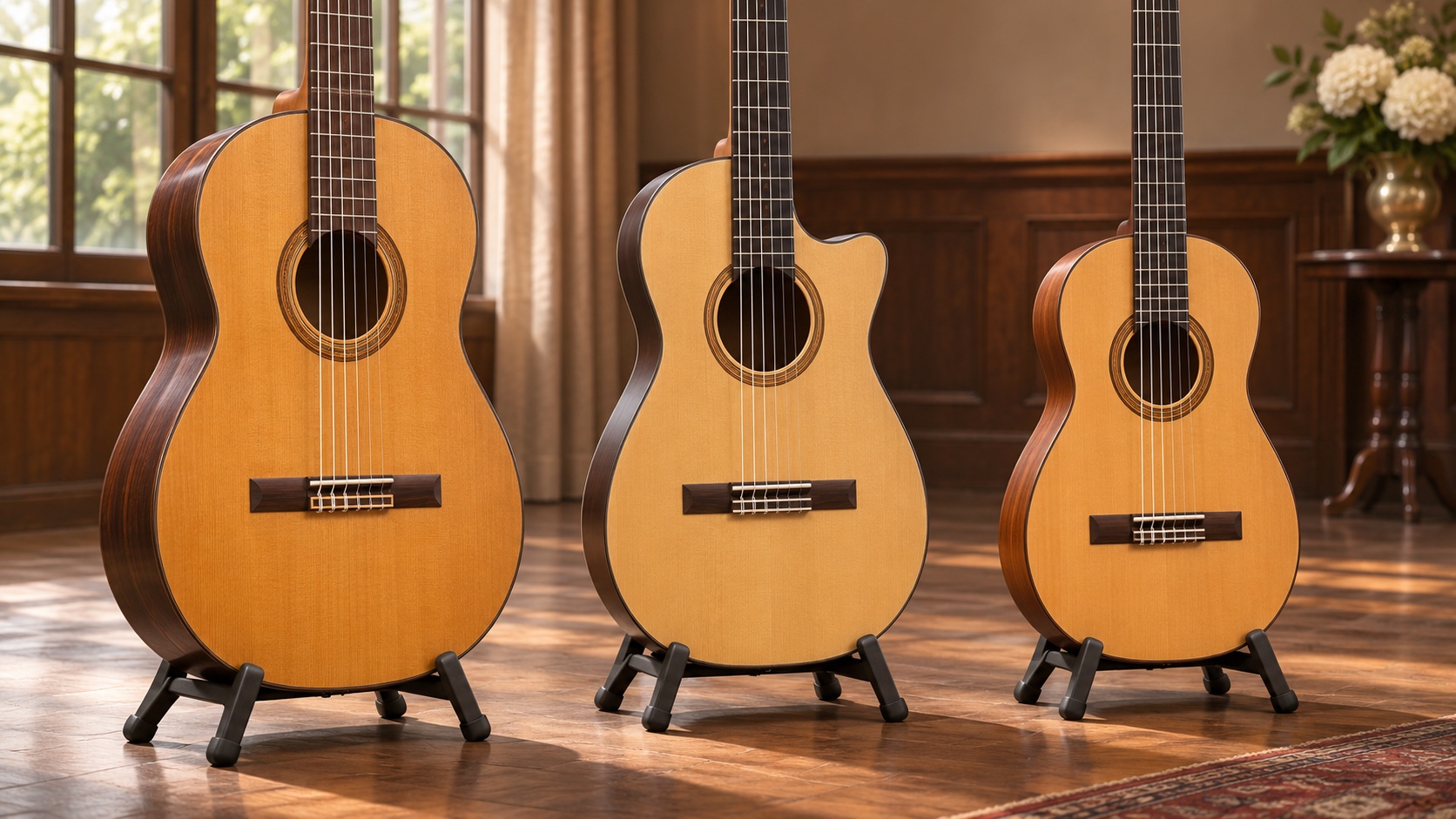
Unamplified classical guitar has a refined voice but limited projection against drums and loud stage instruments. Classical-electric models use piezo systems, microphones, or blends to reach an audience. Amplification can reveal handling noise and requires careful equalization. Steel-string acoustics generally project more aggressively and are available with many stage-ready pickup systems.
A pickup should not rescue an acoustic tone you dislike. Judge the guitar unplugged first unless amplified performance is the only intended use. Then test through a neutral acoustic amplifier or PA, checking feedback resistance, string balance, and control accessibility. The best stage system supports the instrument’s character instead of replacing it.
Cost Should Include the Supporting Setup
Entry prices overlap, so string type does not determine affordability. A trustworthy beginner package needs stable construction, level frets, a playable setup, a protective case or bag, a tuner, spare strings, and suitable support. Classical players may add a footstool or guitar support; steel-string players often need picks, a strap, and perhaps a capo. Used instruments can provide excellent value if humidity damage, neck angle, bridge lift, cracks, and fret wear are checked. A bargain with structural trouble is rarely economical. Reserve part of the budget for professional inspection and adjustment rather than spending every dollar on decorative wood or electronics.
Make the Decision With the Same Musical Test
Tune both guitars accurately and play the same simple material: an open-position chord progression, a single-note melody, a broken-chord pattern, and a passage high on the neck. Match loudness as closely as possible. Notice which guitar responds at a comfortable effort and which makes timing feel natural. Record from several feet away because the player’s position emphasizes different frequencies.
Finally, compare what you want to practice tomorrow. The classical guitar rewards nuanced finger contact and independent voices; the steel-string rewards energetic attack, sustain, and broad accompaniment. The better choice is the one whose constraints feel musically useful rather than merely tolerable.
Do Not Treat Transition Time as Failure
Moving between nylon and steel strings temporarily changes spacing, pressure, callus sensation, and right-hand accuracy. Practice familiar slow material while the hands recalibrate, and avoid judging the new instrument during the first few minutes. Transfer becomes easier when technique adapts deliberately instead of forcing one guitar’s movements onto the other.
Respect the Design You Choose
Use appropriate strings, maintain stable humidity, and arrange a competent setup.
Either construction can become a lifelong instrument when its sound and feel align with the player’s real work.