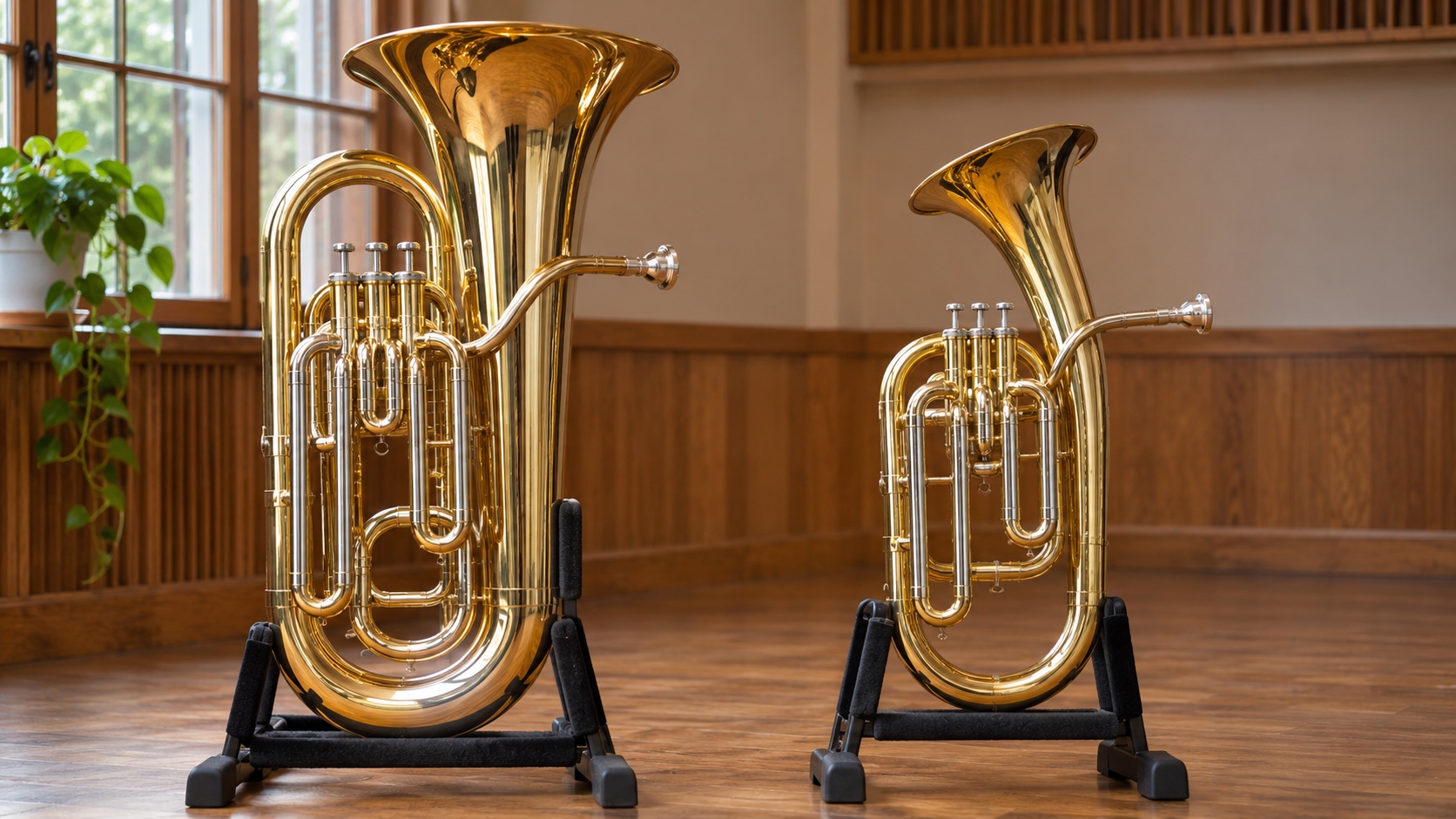
Two Similar Brass Instruments With Different Musical Personalities
A euphonium and a baritone horn can look almost identical to a new player, and both usually read the same bass-clef or treble-clef parts in B-flat. The clearest distinction is not pitch but design: a euphonium generally has a more conical bore and a broader, darker voice, while a traditional baritone keeps more cylindrical tubing and produces a compact, direct sound. Naming is inconsistent across countries, schools, and manufacturers, so the label on the case is only a starting point. Bell shape, tubing expansion, valve layout, mouthpiece receiver, and the role the instrument fills in an ensemble give a more reliable answer.
A: Often in school concert band, but a traditional brass band treats them as separate chairs.
A: A concert euphonium is generally broader through the body and bell than a traditional baritone.
A: Comparable B-flat models share basic fingerings, though a fourth valve adds alternatives.
A: Fit depends on the model, balance, chair height, and the student’s body.
A: Some receivers accept related sizes, but the exact shank must match.
A: No. Many American front-bell models are hybrids or euphonium-like designs.
A: No. It improves low-register tuning and can appear on more than one family.
A: Inventory traditions and publishing conventions developed before labels became consistent.
A: Euphoniums usually sound broader and darker, though player and mouthpiece matter greatly.
A: Use its model number, measurements, photographs, and a technician’s inspection.
Start With Bore Shape, Not Overall Size
The bore is the internal path followed by the air column. In a conical instrument, that path gradually widens through much of the tubing; in a cylindrical instrument, more of the tubing holds a similar diameter before expanding near the bell. Euphoniums lean strongly toward the conical side. Traditional baritones retain a larger proportion of cylindrical tubing, even though neither design is perfectly one type from mouthpiece to bell. That difference influences resistance and resonance. A euphonium often feels as if the sound opens outward when supported by a steady air stream. A baritone can feel more centered and immediate, with a clearer edge at the start of a note. Players should treat those descriptions as tendencies rather than promises. Mouthpiece choice, bell direction, bore size, construction quality, and the player’s own approach can make two examples of the same family feel surprisingly different.
The Bell Reveals Part of the Design
Modern concert euphoniums usually have a large upright bell and a body that widens generously as it rises. A British-style baritone is commonly narrower through the body and ends in a smaller upright bell. Put the instruments side by side and the euphonium often looks fuller through the lower bow and bell throat, while the baritone appears slimmer and more compact.
American school instruments complicate the picture. For decades, manufacturers sold front-bell instruments under labels such as baritone, baritone horn, or baritone/euphonium. Some have proportions closer to a euphonium, some resemble a true baritone, and many occupy the space between. A forward-facing bell describes projection direction, not the complete acoustic identity of the instrument. It should never be the only feature used for identification.
Both Usually Play in B-flat and Share a Practical Range
Most euphoniums and baritones encountered in school bands are built in B-flat and use roughly nine feet of tubing in the open position. They occupy the tenor and baritone register of the brass family, above the tuba and below the trumpet. Their written parts may appear in concert-pitch bass clef or transposing treble clef, depending on local tradition. That shared pitch and notation explains why one instrument can often cover a part written for the other. The useful range overlaps almost completely, but response can guide how players use it. A euphonium’s broad conical profile suits long lyrical lines, warm middle-register melodies, and a substantial low register. A baritone’s focused response can help articulated figures speak clearly and can blend efficiently with tenor horns or trombones. Skilled players can cross those boundaries, so repertoire does not create a rigid rule.
Tone Is the Difference Most Listeners Notice
A characteristic euphonium sound is rounded, deep, and vocal. Its best players connect notes with the ease of a singer while keeping enough core to carry through a large band. The baritone voice is usually leaner and brighter. It can preserve definition when several inner parts move at once, which is valuable in a brass band texture where every line needs its own space.
“Darker” does not mean dull, and “brighter” does not mean harsh. A dark euphonium sound still needs a stable center and clean articulation. A bright baritone can remain warm and flexible. The distinction becomes easiest to hear when the same musician plays both instruments in the same room with comparable mouthpieces. Recordings made in different halls or with different microphones can exaggerate or hide the contrast.
Valve Systems Reflect Different Levels and Traditions
Beginner models of either instrument often have three piston valves. A fourth valve adds alternative fingerings, improves access to low notes, and helps correct certain intonation problems. Intermediate and professional euphoniums frequently use four valves, with three operated by the right hand and a fourth placed on the side for the left hand. Many advanced euphoniums also use a compensating system that reroutes air through extra tubing when the fourth valve is combined with other valves. British-style baritones may also have three or four valves, and professional models can be compensating. The presence of a fourth valve therefore does not turn a baritone into a euphonium. It tells you about range and tuning options, not bore profile. For a beginner, reliable valves, free-moving slides, comfortable hand position, and teacher-approved intonation matter more than owning the most elaborate mechanism.
Brass Bands Give Each Instrument a Separate Job
In a British-style brass band, baritone and euphonium are distinct sections. Baritones often reinforce the inner harmony between tenor horns and trombones. Their focused sound helps define moving lines without covering nearby voices. Euphoniums tend to receive prominent countermelodies, sweeping solos, and technically demanding passages. Their larger sound can bridge the agile upper brass and the foundation of the tubas.
Concert bands in the United States do not always preserve that separation. A score may label a part baritone, euphonium, or baritone/euphonium and expect any suitable tenor low-brass instrument to play it. School inventory may determine the label more than acoustical taxonomy. When a director says “baritones,” the word may refer casually to every student in that section, including players holding instruments that a specialist would classify as euphoniums.
Mouthpieces and Playing Feel Offer More Clues
Euphoniums often use a larger mouthpiece receiver and mouthpieces related to those used on large-bore trombones. Traditional baritones commonly use a smaller receiver and a narrower mouthpiece. A larger mouthpiece can support a broad low register, while a smaller setup may encourage a compact response. Receiver standards vary, however, and forcing an ill-fitting mouthpiece can damage the instrument or create an unstable seal. The best comparison is physical. Sit with both feet grounded, bring each instrument to the face without leaning, and play comfortable long tones at several dynamics. Notice how quickly a note begins, how much air produces a resonant sound, and whether the instrument balances without strain. Then play a familiar scale and a lyrical phrase. Those observations are more useful than trying to decide that one category is universally easier.
Choose According to the Ensemble and the Player
A student joining a school concert band should begin with the instrument the director supports. Matching the section simplifies fingerings, mouthpiece recommendations, repairs, and part assignments. A player entering a traditional brass band should ask whether the available chair is specifically baritone or euphonium. The ensemble’s sound concept will matter more than a generic comparison chart.
Physical comfort deserves equal weight. A smaller player may manage a compact baritone more easily, but a well-balanced student euphonium can also be comfortable. Players who love broad melodies may prefer the euphonium’s expansive response. Those who enjoy clear inner parts may feel at home on baritone. Neither path is a lesser version of the other; each rewards refined breathing, flexible embouchure, accurate rhythm, and attentive listening.
How to Identify an Unlabeled Instrument
Begin by photographing the entire instrument from the front and side, then note the bell direction, bell diameter, number and placement of valves, receiver size, and any serial or model number. Look at how rapidly the main body widens from the valve section toward the bell. A broad lower bow and generous bell throat suggest euphonium proportions, while a slimmer body suggests baritone design. Next, search the exact model number in a manufacturer archive or ask a repair technician. Avoid relying on marketplace listings, because sellers often repeat whatever name appears on an old case. A technician can also identify nonoriginal parts, receiver changes, or an American hybrid design. If classification remains ambiguous, describe the instrument precisely instead of forcing it into a label that its maker never used consistently.
The Short Answer
Euphonium and baritone usually share pitch, range, fingerings, and many ensemble parts, but they are not simply two names for one design. The euphonium is generally more conical, wider, and darker in tone. The traditional baritone is generally narrower, more cylindrical, and more direct. Regional language and hybrid school models blur the boundary, so the instrument’s construction and musical setting should settle the question.
For a player, the practical decision is straightforward: choose the instrument that matches the ensemble, fits the body, responds evenly, and can be maintained locally. Once that choice is sound, musical development depends far more on breath control, tone imagination, and consistent practice than on the word engraved on the bell.
What Changes When a Player Switches
A musician moving from baritone to euphonium does not need to relearn the basic map of the instrument. Familiar B-flat fingerings, breath releases, tonguing syllables, and much of the written range carry over. The first adjustment is usually air use. A euphonium may invite a wider, slower-feeling stream and can punish a player who tries to create breadth by loosening the embouchure. The goal is generous resonance with a stable center, not an unfocused wash of sound. Moving in the other direction can expose articulation and pitch habits. The baritone’s more compact response may make the front of each note easier to hear, including attacks that are late, heavy, or inconsistent. A player accustomed to leaning on the euphonium’s mass should listen for clean releases and avoid pressing the mouthpiece to manufacture brilliance. In both directions, the smartest first session uses middle-register long tones, easy slurs, and a melody already known by ear. Technical range tests can wait until the new balance and resistance feel ordinary. Ensemble listening also changes. A euphonium player may be asked to float above the low-brass foundation without overpowering horns and saxophones. A baritone player in a brass band often needs to fit inside a tightly voiced chord, matching color and note length with neighboring parts. Recording a rehearsal from several seats away can reveal whether the intended role is reaching the audience. What feels prominent behind the bell may sound perfectly balanced in the room.
Why the Names Still Cause Confusion
Instrument terminology grew through regional manufacturing, military bands, community brass bands, and school purchasing rather than through one universal standards committee. Makers adapted instruments for local ensembles, sometimes keeping a familiar sales name while changing bell direction, bore, or valve placement. Publishers then wrote flexible part labels so schools could use whatever equipment they owned. The result is a family tree with overlapping branches rather than a clean pair of boxes.
Translations add another layer. Words related to tenor horn, baritone, baryton, and euphonium do not always point to the same object in different languages. Online listings may use several keywords simply to attract buyers. That history explains the disagreement, but it does not make every claim equally useful. When precision matters, describe the construction and cite the model. “Four-valve compensating euphonium with an upright bell” communicates more than an unsupported family name.