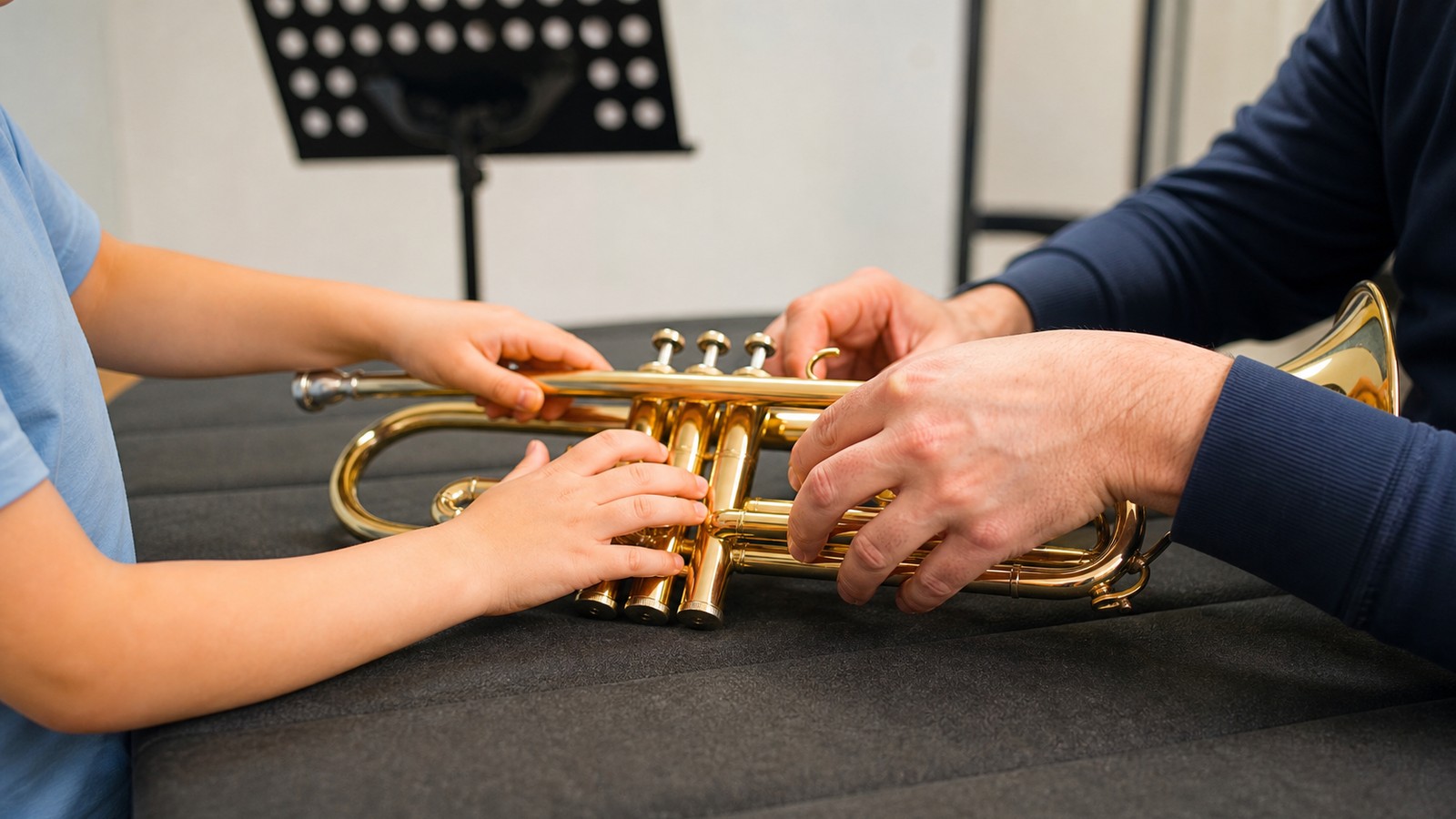
Learning to read sheet music for the trumpet is one of the most rewarding skills a musician can develop. Whether you’re aiming to join a jazz band, play in an orchestra, or simply enjoy performing your favorite tunes, mastering the written language of music will open up a world of opportunity. Reading music may seem intimidating at first, but once you understand the structure and logic behind it, you’ll see it’s just another language — one that connects you to centuries of sound and artistry.
In this comprehensive guide, we’ll break down how to read trumpet sheet music step-by-step, from understanding the staff to interpreting dynamics, articulation, and rhythm. You’ll learn how to connect what you see on the page to what you play through your instrument, transforming ink and paper into brilliant music.
A: Range and transposition conventions keep parts readable across trumpets.
A: Your written C sounds as concert B♭; all notes sound a whole step lower.
A: Written middle C sits one ledger line below the treble staff for trumpet.
A: Typically low A to written A above the staff, expanding gradually.
A: Subdivide “and-a” with a metronome; clap rhythms before playing.
A: Watch for double barlines and courtesy accidentals; slow down at first read-through.
A: Count measures, follow cues, and mark landmarks with rehearsal letters.
A: No—ties join identical notes for duration; slurs connect different notes smoothly.
A: Look for mute type and “open” indications; adjust dynamics and intonation.
A: If you’re given concert pitch, transpose or use a C trumpet; otherwise read transposed parts.
Understanding the Basics of Sheet Music
Before diving into trumpet-specific details, it’s essential to understand what sheet music actually represents. Sheet music is a visual language for sound — it tells musicians what to play, how long to play it, and how to shape the notes.
At the heart of this system is the musical staff, a set of five horizontal lines and four spaces. Each line and space represents a specific pitch. When you add clefs, key signatures, time signatures, and notes, the staff becomes a complete guide to how the music should sound.
For trumpet players, the staff is written using the treble clef, also known as the G clef. The curl of the clef circles the second line of the staff, designating it as the note G. Every other line and space is then named relative to that point.
The Treble Clef and Trumpet Transposition
Unlike instruments such as piano or flute, the trumpet is a transposing instrument. This means that the note you see on the page doesn’t match the concert pitch sound that comes out of the instrument. For the B♭ trumpet, when you play a written C, the sound produced is actually a concert B♭.
This transposition allows trumpet players to switch between different keyed instruments (like B♭, C, or E♭ trumpets) without having to relearn all their fingerings. The written music stays consistent, even though the sounding pitch changes.
So, when you read trumpet sheet music in treble clef, always remember: the notes are written one whole step higher than what they sound in concert pitch. This distinction is crucial when playing with other instruments.
The Musical Staff: Lines, Spaces, and Notes
In treble clef, the five lines from bottom to top represent E, G, B, D, and F — which you can remember with the mnemonic “Every Good Boy Does Fine.” The four spaces spell out F, A, C, and E — simply “FACE.”
Each of these notes corresponds to a valve combination and pitch on your trumpet. For example:
E (bottom line) = open valves or 1st valve depending on octave
G (second line) = open valves
C (third space) = open valves
F (top line) = 1st valve
Learning the relationship between these visual symbols and their trumpet fingerings is the foundation of reading music fluently. Regular practice reading simple melodies while saying the note names aloud can solidify this connection quickly.
Key Signatures: The Roadmap of the Music
Every piece of sheet music begins with a key signature, a set of sharps or flats written after the clef. This tells you which notes are altered throughout the piece. For example, if you see one sharp (♯), that’s F♯ — the key of G major for most instruments, but A major for the B♭ trumpet.
This is where transposition plays another key role. A piece in concert B♭ major (two flats) will be written for trumpet in C major (no sharps or flats). Understanding key signatures helps you anticipate which fingerings you’ll need and which pitches will appear most often in the piece.
Common trumpet keys include:
C major (concert B♭)
D major (concert C)
G major (concert F)
F major (concert E♭)
As you practice, you’ll start recognizing these tonal centers instinctively, just as you might recognize familiar chords or progressions in popular music.
Time Signatures and Rhythm
The time signature appears at the beginning of the piece and tells you how the rhythm is organized. The top number indicates how many beats are in each measure, and the bottom number shows what type of note gets one beat.
For instance:
4/4 means four quarter-note beats per measure (the most common “common time”).
3/4 means three quarter-note beats per measure (used in waltzes).
6/8 means six eighth-note beats per measure (common in marches and faster pieces).
Trumpet players must pay careful attention to rhythm because precision is essential when playing in ensembles. Practicing with a metronome and clapping rhythms before playing helps you internalize timing and prevents common mistakes such as rushing or dragging.
Reading Notes and Intervals
Each note on the staff has both a pitch (how high or low the sound is) and a duration (how long it lasts). Note shapes tell you duration:
Whole notes are open circles (four beats in 4/4 time)
Half notes have open heads with stems (two beats)
Quarter notes are filled circles with stems (one beat)
Eighth and sixteenth notes have flags or beams (shorter durations)
Trumpet players often find that reading intervals — the distance between two notes — helps them play more fluidly. For instance, moving from C to E is a “third,” and from C to G is a “fifth.” Recognizing these patterns visually and hearing them mentally allows you to predict how they feel on your instrument, even before you play them.
Ledger Lines: Reading Beyond the Staff
As trumpet music progresses, you’ll encounter notes that extend above or below the standard five-line staff. These are written using ledger lines, small lines added for notes like low A or high C.
A good exercise is to practice reading and playing these extended notes slowly, connecting them to their positions within your trumpet range. Over time, the higher register (like high C, D, E) becomes as familiar as middle C.
Dynamics: The Emotion in the Notes
Music isn’t just about hitting the right pitches — it’s about expression. Dynamics indicate how loudly or softly to play. They’re written using Italian abbreviations:
p (piano) = soft
f (forte) = loud
mf (mezzo-forte) = moderately loud
mp (mezzo-piano) = moderately soft
crescendo (<) = gradually get louder
decrescendo (>) = gradually get softer
For trumpet players, mastering dynamics is key to beautiful phrasing. The instrument naturally projects well, so controlling soft passages takes finesse. Focus on air control, embouchure stability, and breath support to maintain tone at every volume level.
Articulation and Expression Marks
Articulations tell you how to play each note. These include:
Staccato (a dot above/below the note): play short and detached.
Tenuto (a line): play full length, with gentle emphasis.
Accent (>): play forcefully or with extra attack.
Slur (curved line over multiple notes): play smoothly, without tonguing each note.
In trumpet playing, articulation is executed with the tongue. “Tuh,” “Duh,” and “Lah” are common syllables for different attacks. Learning to coordinate tonguing with valve changes is one of the most important aspects of playing cleanly and musically.
Understanding Rests and Silence
Rests are symbols indicating when to not play. They’re as vital as the notes themselves — silence shapes the rhythm and gives phrasing clarity. Each type of rest corresponds to a note value: whole, half, quarter, eighth, and so on.
Counting rests properly ensures ensemble precision. Many trumpet players count silently or subdivide rhythms in their head to maintain timing. The best players “play the rests” with the same awareness as the notes.
Reading Accidentals: Sharps, Flats, and Naturals
Occasionally, you’ll encounter symbols that alter a note’s pitch temporarily:
Sharp (♯) raises a note by a half step.
Flat (♭) lowers a note by a half step.
Natural (♮) cancels a previous sharp or flat.
These appear before individual notes and remain in effect for the entire measure unless canceled. Trumpet players must adjust their valve combinations accordingly — for example, F becomes F♯ by using the 2nd valve instead of open.
Accidentals are especially common in jazz and modern compositions, where chromatic movement adds richness and complexity to the sound.
Putting It All Together: Sight-Reading for Trumpet
Sight-reading is the ability to play a piece of music you’ve never seen before accurately and expressively. This skill develops over time through consistent exposure and practice. Start with simple etudes or hymn tunes, and gradually increase complexity.
Here’s a proven approach:
Scan the key signature — note sharps or flats.
Check the time signature — know the rhythmic framework.
Glance at tempo and dynamics — get the mood.
Mentally sing through the first few measures — imagine the sound.
Play steadily — don’t stop for mistakes; keep the rhythm flowing.
The more you practice sight-reading, the faster your brain links visual symbols with the physical sensations of trumpet playing.
Ear Training and Musical Awareness
While sheet music is visual, trumpet playing is deeply auditory. Developing a good musical ear enhances your ability to read. When you can hear intervals, recognize rhythms, and anticipate phrasing, you don’t just read notes — you understand them.
Try these exercises:
Sing the note names as you play.
Play simple melodies by ear, then check against written notation.
Record yourself playing from sheet music and listen for tone and accuracy.
A strong ear bridges the gap between sight and sound, allowing you to interpret music intuitively rather than mechanically.
Common Challenges When Reading Trumpet Music
Even experienced players face hurdles when reading sheet music. The most frequent challenges include:
Transposition confusion: forgetting that written C sounds as B♭.
Overblowing high notes: neglecting breath control and embouchure balance.
Rhythmic inconsistency: not internalizing pulse or subdividing beats.
Ignoring dynamics and phrasing: playing “notes” instead of “music.”
Overcoming these challenges takes patience and awareness. Slow practice, careful listening, and using a tuner or metronome can dramatically improve precision and confidence.
Tips for Mastering Trumpet Sheet Music
To become a fluent music reader, integrate reading into your daily routine. Here are some effective habits (in paragraph form, not bullets):
Start each practice session with a short sight-reading exercise. Choose simple études or excerpts from method books like Arban’s Complete Conservatory Method or Clarke’s Technical Studies for the Cornet. Focus on accuracy first, then speed. When learning a new piece, play the rhythms on one note before adding pitches — this isolates timing and helps you feel the structure. As you grow more comfortable, transpose short melodies to different keys to reinforce interval recognition and flexibility. Listening to professional trumpet players while following along with their sheet music can also deepen your understanding of phrasing and articulation. Finally, maintain a growth mindset — every piece of music you read strengthens your fluency and expands your expressive palette.
The Role of Interpretation and Style
Reading the notes correctly is only half the story. True musicianship lies in interpretation — shaping phrases, controlling tone color, and understanding the stylistic context. A jazz chart, for instance, will use swing rhythms and improvisational phrasing, while a Baroque piece demands crisp articulation and lightness. Classical trumpet repertoire emphasizes precision, clarity, and breath control, whereas modern or cinematic music might call for sustained, powerful tones.
By studying recordings, historical context, and performance practice, you can bring life to the notes on the page. Sheet music gives you the framework — your artistry fills in the emotion.
Connecting Reading with Performance
As you advance, you’ll find that reading and performing become inseparable. You won’t have to consciously translate every symbol — your eyes, brain, and fingers will work together fluidly. This automaticity frees you to focus on expression, ensemble blend, and communication with your audience.
Trumpet players who read confidently can explore vast musical landscapes: from Baroque fanfares and symphonic masterpieces to big band jazz and film scores. The skill of reading opens doors to collaboration, creativity, and professional growth.
Final Thoughts: Turning Notes into Music
Learning how to read sheet music for trumpet is more than memorizing symbols; it’s learning to tell stories through sound. Every dot, line, and curve on the page represents human expression waiting to be brought to life through your breath and brass.
Take your time with each concept, celebrate small victories, and remember that even the greatest players once struggled with their first scales and rhythms. With consistent practice, patience, and passion, the black and white lines of sheet music will transform into a vibrant world of melody, harmony, and rhythm — all resonating from your trumpet.
Reading music is not the end goal; it’s the key to unlocking your full musical voice. So pick up your horn, open that score, and let your journey begin.