The Sousaphone Is a Tuba Designed Around a Moving Player
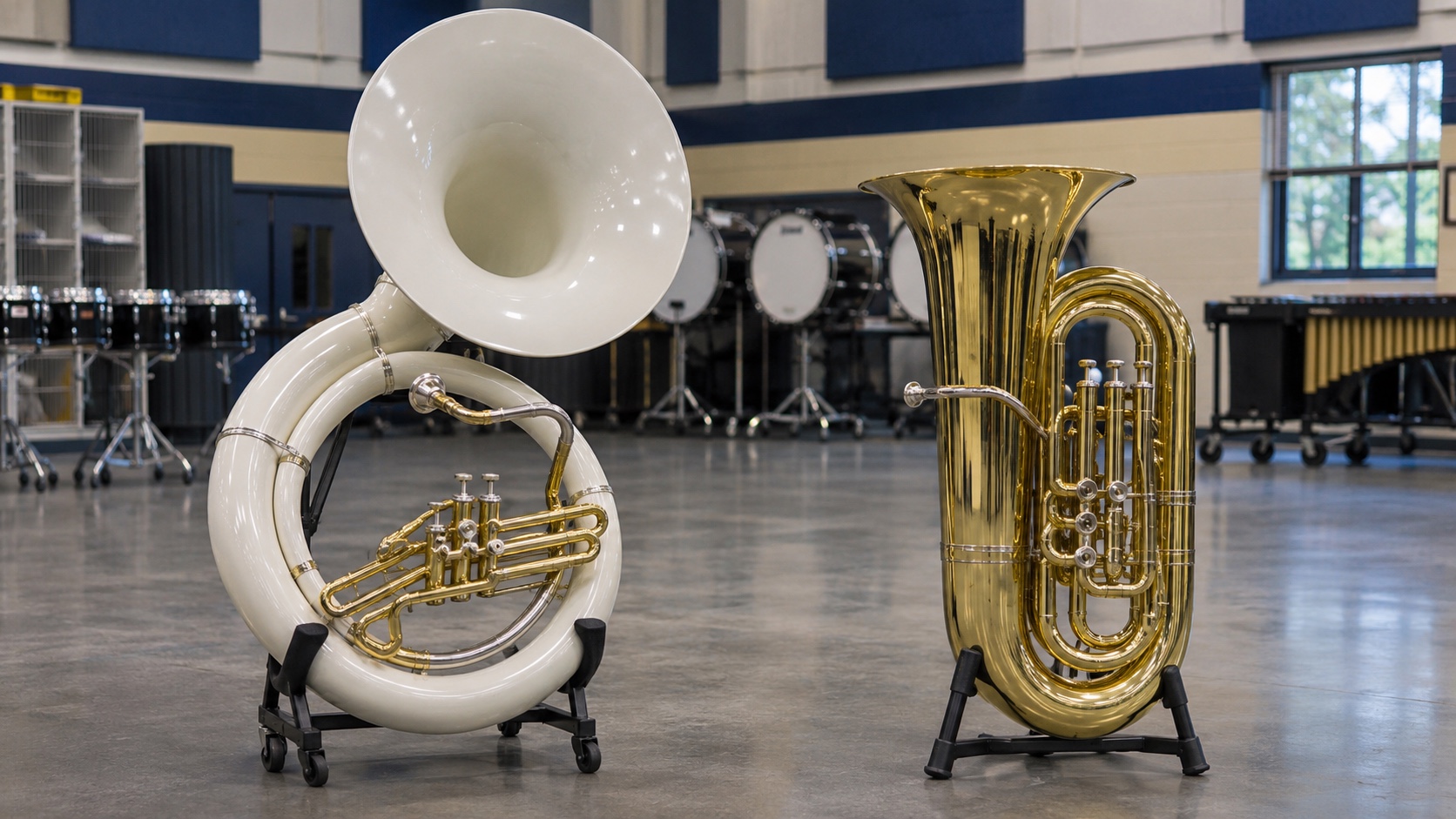
A sousaphone and a concert tuba produce the lowest brass voice through the same basic process: the player buzzes into a cup-shaped mouthpiece and valves redirect air through different lengths of tubing. Their most important difference is physical design. A sousaphone wraps around the body, rests on the shoulder, and points a large bell forward so a marching sound projects toward the audience. A concert tuba sits on the lap or a stand and usually sends its bell upward, favoring seated balance and a blended ensemble tone. They can share pitch and fingerings, but they solve different performance problems.
A: Yes. It is a tuba family instrument designed around carrying and forward projection.
A: Many use related tuba mouthpieces, but receiver fit and the program’s recommendation must be checked.
A: BB-flat versions share basic patterns; other tuba keys use different relationships.
A: Model and material vary, and shoulder-borne weight feels different from lap-supported weight.
A: No. It is chosen mainly for reduced weight and field practicality.
A: It can, though projection and seating may not match the director’s desired balance.
A: Specialized carriers exist, but a sousaphone is purpose-built for that job.
A: Removal supports transport, storage, orientation, and repair access.
A: The better-fitting, well-maintained instrument in a supported program is easier.
A: School inventory or rental is often wiser until size, key, and ensemble needs are clear.
Body Shape Separates Them Immediately
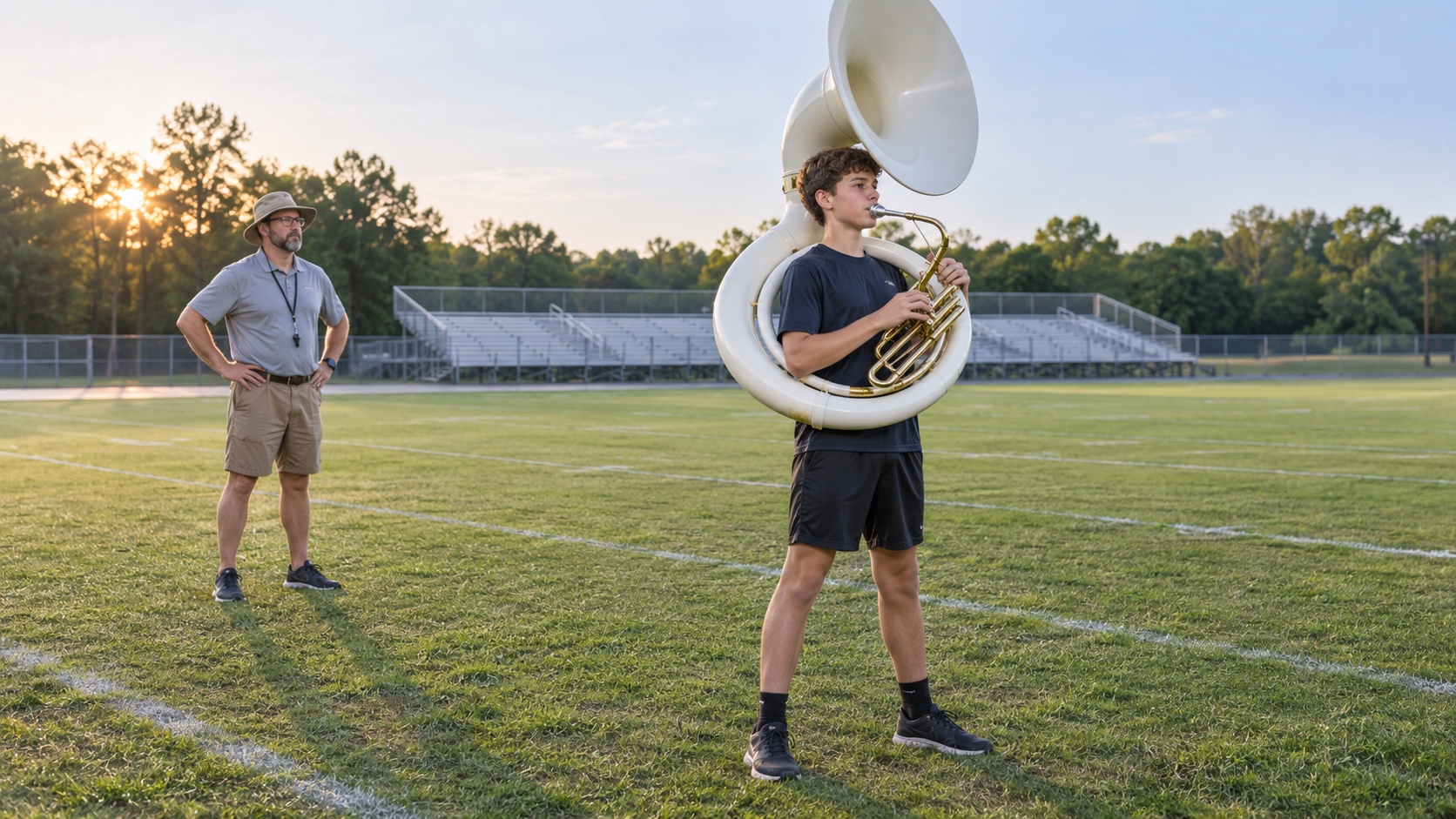
The sousaphone forms a broad circle around the player. Its main branches pass in front of and behind the torso, while the bell attaches above the head. The shoulder carries much of the load, leaving the hands to stabilize the body and operate the front-action valves. A concert tuba coils its tubing into a tall oval held in front of a seated musician. Top-action or front-action valves sit within reach, and the lower bow rests on the lap, chair, or a purpose-built stand. The compact vertical arrangement occupies less horizontal space in a concert row.
Bell Direction Changes How Sound Reaches the Room
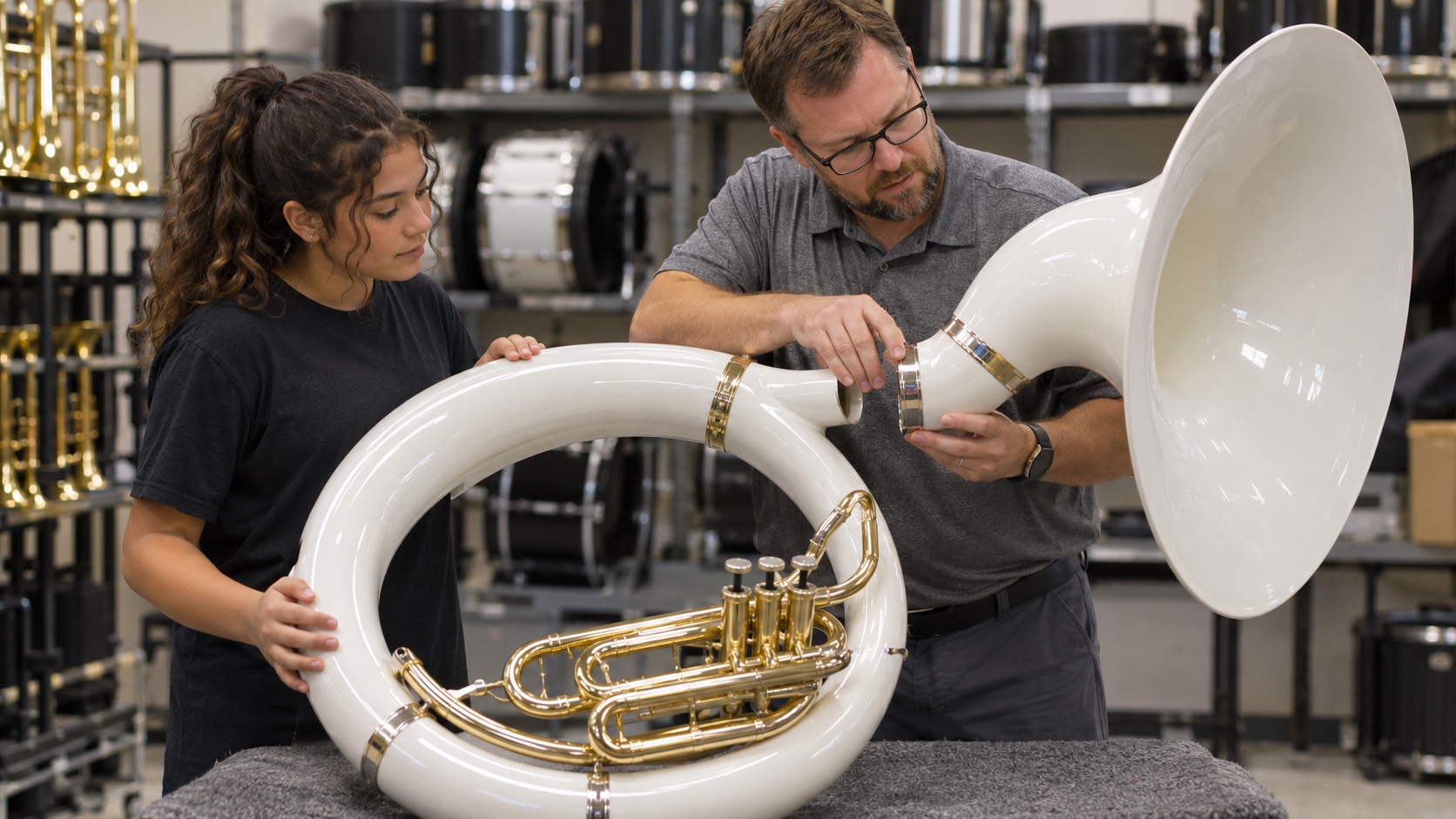
The sousaphone bell faces forward. On a football field or parade route, that direction helps the low line reach listeners instead of sending most energy toward the sky. The bell can often be removed for transport and rotated during assembly, so correct alignment and secure attachment matter.
Most concert tubas use an upright bell. Reflections from the room and ensemble shell help distribute the sound, allowing it to blend under woodwinds, brass, and percussion. Forward-facing recording-bell tubas also exist, which proves that bell direction alone does not define the entire family.
Pitch and Fingerings Often Overlap
School sousaphones are commonly built in BB-flat, the same fundamental pitch as many beginner concert tubas. Three front-action valves are typical. A student switching between comparable BB-flat instruments can use the same basic valve patterns, although the response and tuning tendencies may differ. Concert tubas also come in CC, E-flat, and F. Those instruments serve different traditions and advanced repertoire, and their fingerings do not map identically to a BB-flat beginner instrument. The word “tuba” therefore covers a broader range of keys and configurations than “sousaphone.”
Materials Affect Weight, Durability, and Tone
Brass sousaphones offer a traditional appearance and a strong, complex sound, but their weight and dent risk demand careful handling. Fiberglass models reduce carrying weight and resist some field damage. Their white bodies are common in school programs, though the valve section and other working parts still require normal brass-instrument care.
Concert tubas are usually brass, with lacquered or silver-plated finishes. Their bodies are protected from marching collisions but remain vulnerable to dents when placed on chairs or carried through doorways. Material should be considered alongside balance, repair access, weather, and the program’s maintenance resources.
Weight Is Experienced Differently
A sousaphone distributes mass around the torso and places a contact point on the shoulder. That makes walking possible, but long rehearsals can create pressure and fatigue if the instrument is poorly fitted. Students should learn safe lifting with assistance and use scheduled breaks. A concert tuba transfers weight to the lap or a stand. The player does not carry it while performing, yet a large body can still force awkward reaching. Smaller tubas, adjustable stands, and chair changes can give young students a healthier position without compromising the breathing space.
Each Instrument Belongs in a Different Visual and Musical Setting
Sousaphones are built for marching bands, pep bands, parades, and outdoor events. Their circular silhouettes keep the instrument attached while the player turns, steps, and performs choreography. Forward projection helps define bass rhythm across a large field.
Concert tubas belong naturally in concert bands, orchestras, brass ensembles, and solo settings. Their shapes support seated technique, nuanced dynamics, and a broad palette of articulation. A school may assign the same musician to concert tuba indoors and sousaphone during marching season.
The Sound Difference Is Real but Not Absolute
A well-played concert tuba often produces a broad, enveloping foundation that merges with the ensemble. A sousaphone tends to emphasize direct projection and rhythmic clarity, especially outdoors. Fiberglass and brass versions may respond differently, and bell design changes what the player hears behind the instrument. Player skill remains decisive. Breath support, articulation, mouthpiece, instrument condition, and listening habits can outweigh the family label. A weakly supported concert tuba will not become warm merely because its bell points upward, and a skilled sousaphone player can shape a remarkably refined phrase.
Valve Layout and Maintenance Reflect the Job
Most student sousaphones place three pistons in a removable front-action section. Removability can simplify certain repairs and packing, but every connection must remain aligned and secure. Marching exposure makes regular valve oil, slide care, and moisture removal especially important.
Concert tubas may use three or four pistons, rotary valves, or more advanced combinations. A fourth valve expands low-register fingering options. More mechanisms increase capability but also service requirements, so beginner programs often value simple, rugged systems.
Transport Requires Different Planning
A sousaphone separates into body and bell for many cases. The case can be extremely large even when it has wheels. Programs need storage racks, loading procedures, and enough vehicle space to prevent bells from being crushed under other equipment. Concert-tuba cases are also substantial, but their long rectangular form may fit different storage systems. Never lift either case by an extended wheel handle alone. Secure latches, clear stairs, and use two people when size or weight compromises safe control.
Switching Between Them Takes Adjustment
The valve fingerings may feel familiar, but the mouthpiece angle, visual field, and sound feedback change. A sousaphone player hears the bell from behind and above, while a concert-tuba player receives more reflected room sound. The first rehearsal should focus on balance and tone rather than maximum volume.
Marching adds breathing while moving, step timing, spacing, and bell orientation. Returning indoors requires a recalibrated dynamic because field volume can overwhelm a concert room. Long tones, scales, and familiar excerpts help the musician reset efficiently.
Which One Should a Beginner Choose?
The ensemble usually chooses. A student entering concert band needs the tuba size and key supported by the director. A marching student should use the program’s matched sousaphone inventory whenever possible. Buying independently without knowing the required configuration risks an expensive mismatch. If both are available, test physical fit with the director. Pain, numbness, restricted breathing, or unsafe lifting are not acceptable. The best beginner setup allows correct posture, dependable mechanical response, and access to instruction and repairs.
Why One Does Not Replace the Other Everywhere
A sousaphone can play a concert part, and some groups use one indoors for stylistic reasons. Its forward bell and physical footprint, however, may disrupt balance or seating. A concert tuba can appear in a parade on a carrier, but it does not surround the body with the same stability and projection.
Design follows purpose. The sousaphone prioritizes mobility, visibility, and outward sound. The concert tuba prioritizes seated control, tonal integration, and a wide range of keys and valve systems. Understanding that purpose makes the comparison clearer than ranking one as universally superior.
Weather and Venue Change the Care Routine
Outdoor performance exposes a sousaphone to heat, cold, dust, moisture, and rapid temperature changes. Cold metal can affect valve action and pitch, while direct sun can make surfaces uncomfortable. Programs should provide water breaks, shaded staging when possible, and a clear policy for severe weather. The instrument must be dried and inspected after wet events rather than closed immediately in its case. Concert tubas live in more controlled rooms but still move through loading docks, buses, and backstage corridors. Condensation forms during normal playing, and crowded rehearsal spaces create collision risks. Neither instrument is maintenance-free; the hazards simply arrive in different forms.
Section Balance Depends on More Than Bell Size
A row of sousaphones can produce enormous visual and acoustic impact, yet effective marching balance comes from matching note length, articulation, and air speed. Players who compete for volume often create spread tone that carries less clearly. Directors may ask the section to aim bells consistently so the sound reaches the audience as one voice.
Concert-tuba sections face a different blend problem. Their sound must support without obscuring bassoons, low strings, euphoniums, or bass trombones. Seating, shell placement, and room resonance all influence the result. A smaller, centered sound can sometimes provide more usable foundation than the largest possible tone.
The Practical Conclusion
Choose a sousaphone for a player who must move while projecting the bass line forward. Choose a concert tuba for seated indoor playing and access to the broader tuba repertoire. When one student uses both, teach each instrument as its own physical environment while preserving shared fundamentals: relaxed breath, centered buzz, clean valves, attentive rhythm, and safe handling.
History Explains the Circular Design
Earlier bass instruments used in military and civic bands had to balance acoustic power with mobility. The helicon wrapped around the body and provided a practical starting point. The sousaphone developed from that lineage with a large bell intended to distribute the bass voice effectively in outdoor ensembles. Its modern forward-facing form became visually inseparable from American marching bands, even though early versions used different bell orientations.
The concert tuba followed a broader set of design paths. Makers experimented with upright and recording bells, piston and rotary valves, and instruments in several keys. Orchestral, band, and regional traditions favored different solutions. That history is why “tuba” names a family while “sousaphone” points to a more specific carrying form.
Buying Decisions Should Follow the Program
Families rarely need to purchase a sousaphone for a beginning school player. Matched school instruments simplify visual uniformity, parts inventory, storage, and instruction. If an independent purchase is required, the director should approve key, material, bore, bell size, case, and finish before money changes hands. A model that looks impressive online may not fit the section’s racks or repair system. Concert-tuba purchases also need caution because “beginner tuba” does not identify one size. A compact BB-flat model may fit a young student, while a larger four-valve horn may serve an older player. Test breathing position, hand reach, chair clearance, and transport. The cheapest instrument becomes expensive when poor fit prevents practice or unserviceable valves shorten its useful life.
Microphones Do Not Erase the Difference
Amplification can make either instrument audible, but it does not change where the sound originates or how the player manages the body. A microphone placed near a forward sousaphone bell captures a direct signal and may exaggerate articulation or wind noise. An upright tuba often benefits from placement that captures both bell output and room response.
Sound engineers should avoid forcing players into unsafe positions for microphone convenience. In a mobile setting, secure wireless equipment must not interfere with bell attachment, valves, vision, or movement. In a concert setting, a little distance often captures a more natural low-frequency blend. The instrument’s design still shapes the source before electronics enter the chain.